1983: “Forever! And Ever!”
Written by Ian Douglass, author of A Decided Novelty: The Essential Guide to Black Pro Wrestling History, 1880–1950.
Part of Violent People’s FUNKIN’ FALL series: View the full index.
By the time 1983 rolled around, the retirement of former NWA World Heavyweight Champion Terry Funk that had been teased for nearly three full years was now imminent, and the difference in the way the seismic event would be handled would be drastically different depending on the country you observed it from.
On its surface, the withdrawal of the Amarillo, Texas legend from the pro wrestling landscape could have been identical to the abrupt disappearances of so many other stars from the territorial system. In North America that’s essentially what happened, as no mention of Funk’s departure was stated or acknowledged in the press that covered the siloed territories of North America that tended to ignore what happened outside of their borders.
Elsewhere, things were palpably different. Within the Japanese wrestling scene of 1983, Funk’s retirement became the centerpiece of the entire year, and the events that encircled it had repercussions that echoed for well over a decade into Puroresu’s pro wrestling future.
For roughly a decade, the Funk brothers — Dory Jr. and Terry — had been among the top wrestling attractions in Japan. In fact, as the 1980s dawned, it was famously said that the Funks were the true aces of All Japan Pro Wrestling, exceeding the popularity of native stars Giant Baba and Jumbo Tsuruta, and rivaling that of New Japan Pro Wrestling’s unquestioned star, Antonio Inoki.
Texas wrestling icon Stan Hansen, who was personally recruited to wrestle by the Funks, and whose popularity in Japan would eventually eclipse that of his mentors, went so far as to say that it was the presence of the Funks that provided the gap in popularity between All Japan and New Japan, and underscored how the real comparison of top wrestling attractions between the companies was between Antonio Inoki and the two Funks.
Terry’s international popularity afforded him an opportunity that was limited to only a handful of talents during that era. He could travel to Japan to be paid handsomely by Baba for a few months out of the year, while spending the bulk of the annual calendar wrestling in the various territories of the United States. This arrangement made appearances by Terry less frequent than those of Dory Jr., to whom Baba had entrusted possession of the NWA International Heavyweight Championship.
Making Terry a seasonal attraction in Japan helped to preserve his tremendous popularity, but it is also the most likely reason why he did not hold any championships in All Japan Pro Wrestling after the Funks returned the NWA International tag team belts to Giant Baba after the reclaiming them after the downwall of the original Japan Pro Wrestling Association, and defending them in their own Amarillo-based wrestling promotion.
The major caveat to Terry’s somewhat surprising shortage of championship success during the peak of his popularity in Japan was the fact that the Funks were still presented as the most dominant tag team attraction in All Japan when it arguably mattered the most — during the annual World’s Strongest Tag Team Tournament. Notwithstanding the relative stranglehold that Giant Baba and Jumbo Tsuruta maintained the top tag team championship in the company, the fundamental takeaway from the annual tournament was that the unified Funk tag team was truly the most dominant pairing in the business.
The Funks won the inaugural tournament in 1977 when it was introduced as the World Open Tag Team Championship, then won it again in 1979 and 1982. This final win in December 1982, which squarely established the Funks’ run of three wins in six years as dynastic, was likely intended as a retirement gift from Baba to Terry, as Terry had announced in 1980 that he would retire in three years due to a knee injury.
A Year Built Around Goodbye
It just so happened that 1983 was the year All Japan Pro Wrestling temporarily did away with its annual Champion Carnival singles tournament in favor of a six-month series of unrelated events called the “Grand Champion Carnival.” The mid-year spectacle was seemingly intended to shape and accentuate the new direction of AJPW, and would conclude with Terry’s retirement on the last day of August. Unbeknownst to anyone, some of its unintended consequences of Funk’s six-month retirement countdown would ultimately reshape the entire pro wrestling scene of Japan heading into the 1990s and beyond.
As a case in point, the Carnival opened with the Lou Thesz Cup League Tournament, which had a stated intention of elevating young native stars to the next level, as one of its advertised prizes was the right to travel overseas on a learning expedition. In the past, such opportunities were usually reserved for only the most promising stars who displayed the greatest potential, like Jumbo Tsuruta, whose training had been personally supervised by the Funks.
The outcome of the Lou Thesz Cup couldn’t have emphasized the point any further. The tournament was won by Shiro Koshinaka, but runner-up Mitsuharu Misawa was also given the opportunity to travel abroad as a reward for the tremendous skill he displayed during the final round.
This overseas excursion sent Misawa to Mexico, and when he returned to All Japan in 1984, he was rebranded as the second Tiger Mask and cast as the new star of the junior heavyweight division. It was a gimmick that Misawa would maintain until May 1990, when he memorably removed the mask in the middle of the ring (with a little help from Toshiaki Kawada) and began his meteoric rise to the top of the company.
Speaking of the junior heavyweight division, the urgency for Misawa to become the new focal point of the division was also created during the Grand Champion Carnival. Atsushi Onita, the incumbent star of the All Japan junior heavyweight division, suffered a career-threatening leg injury during a defense of his junior heavyweight championship against Hector Guerrero, and was forced to vacate his championship.
Onita would never be the same, and after formally retiring from wrestling in 1985, he would return with a completely reimagined style and mannerisms based heavily on the in-ring idiosyncrasies of Terry Funk himself. The inevitable result of Onita’s Funk-inspired style — which necessitated a willingness to absorb evident damage to the point of physical mutilation — was the birth of Frontier Martial Arts Wrestling, a Japanese wrestling promotion that did as much to promote the hardcore, deathmatch style of pro wrestling as any company in history.
Peripheral events aside, the sequence that concluded the first phase of the Grand Champion Carnival likely reflected the booking direction Giant Baba would have gone in had he not wished to be so charitable to the Funks in light of Terry’s impending retirement.
The “100,000 Dollar World’s Strongest Tag Team League Rematch” was a double-round-robin tournament between the top-three teams from the World’s Strongest Tag League tournament just a few months earlier. Occupying the latter half of April, the mini-tournament saw the Funks notch just a single win against a loss and two draws, as American stars Bruiser Brody and Stan Hansen emerged victorious in the abbreviated tournament format.
The Farewell Tour
Terry traveled home to the U.S. for the next three months before returning to Japan and enjoying what can only be described as a retirement gift in the form of Baba’s booking during the “Terry Runk Farewell Series.” Over the course of what were presumed at the time to have been the final 30 matches of Terry Funk’s wrestling career — all of which were either main-events or semi-main-event bouts — he triumphed 27 times in what were predominantly tag team bouts, with his three non-victories all ending in double-count-out draws.
During that timeframe, Baba completed his transition away from his established aces of the prior decade — including himself — and reshaped All Japan around a new cast of stars. The first of these events would occur on the night of Funk’s retirement when Jumbo Tsuruta defeated Bruiser Brody for the NWA International Heavyweight Championship.
It was a title that had been monopolized by Brody and Dory Jr. since its return to All Japan early in 1981. While still in possession of the PWF Heavyweight Championship, Baba famously declared that Tsuruta was the new native ace of All Japan, completing a passing of the torch that had begun more than a decade earlier when Baba hand-selected Jumbo for grooming as his successor.
A little more than a week later, Baba would complete the sequence by dropping the PWF title to Stan Hansen, squarely cementing Hansen alongside Brody as the premier foreign stars around whom the next decade would be built, and supplanting the Funks as the company’s gaijin aces in the process.
Again, this confirmation of Hansen was itself an ode to Terry’s influence beyond the squared circle. Not only had Terry been responsible for initially recruiting Hansen into the wrestling business, but he had also played a critical role in mediating the discussions that helped Baba poach Hansen away from Antonio Inoki and New Japan Pro Wrestling and onto the AJPW roster.
As these events unfolded, All Japan’s fans may not have been aware of the fact that they were witnessing a proverbial changing of the guard in real time. At that moment, all eyes were on Terry Funk. On the same night that Jumbo Tsuruta — another Funk brothers trainee — enjoyed his long-overdue ascent to the top of the AJPW wrestling hierarchy, Japanese wrestling fans would see what they believed was their final glimpse of Terry Funk in a wrestling capacity. The evening was arranged to be one of the most emotional nights in the history of the industry.
Forever! And Ever!
The capstone of the entire Grand Champion Carnival was Terry Funk’s retirement match, which was a tag team bout pitting the Funks against Stan Hansen and Terry Gordy. Undoubtedly, Brody would have been involved in the bout in lieu of Gordy had he not been occupied with his title defense against Tsuruta in the previous match.
Even before the sounds of the Funks’ “Texas Broncos” theme filled the Kuramae Kokugikan arena, the nearly 14,000 fans in attendance were already chanting Terry’s name, and as the first chords of the theme were struck, they erupted in applause.
Terry and Dory Jr. were absolutely mobbed by the fans on their way to the ring, but they restrained themselves long enough to respectfully applaud Terry’s wife and daughters, who were seated at ringside. The introduction of Terry’s family served as the kickoff to a touching pre-match ceremony during which trophies and gifts were dispensed to Terry.
When the seven-minute tribute came to a close and the final bouquets of flowers were distributed, Stan Hansen and Terry Gordy finally entered the arena to far less resistance from the fans, and climbed into the ring. The instant the streamers from the pre-match introduction finished raining down upon the wrestlers, Hansen rained punches on Terry Funk and chucked him out to the arena floor. That’s where the match fittingly began with a brawl between the two Texans.
If the opening of the bout had showcased one element of what made Terry such a captivating performer — his tendency to brawl wildly and bravely while convincingly selling the the damage — its ending highlighted Funk’s willingness to take risks and adapt his repertoire. With Dory Jr. and Stan Hansen occupied outside the ring, Terry avoided a top-rope splash from Gordy, climbed to the top turnbuckle, and then completed a beautiful diving sunset flip onto Gordy from the top rope to provide a memorable conclusion to his remarkable career.
The Funks were allotted no time to celebrate; Hansen mauled Terry after the bell, and then savagely kicked the dazed Funk’s right leg as it hung vulnerably from the top rope. It was the same injured leg that had been cited as the justification for Terry’s retirement, and the aftermath of Hansen’s assault reinforced the notion that Funk’s departure from the sport had not been a choice, and was now even more of a necessity.
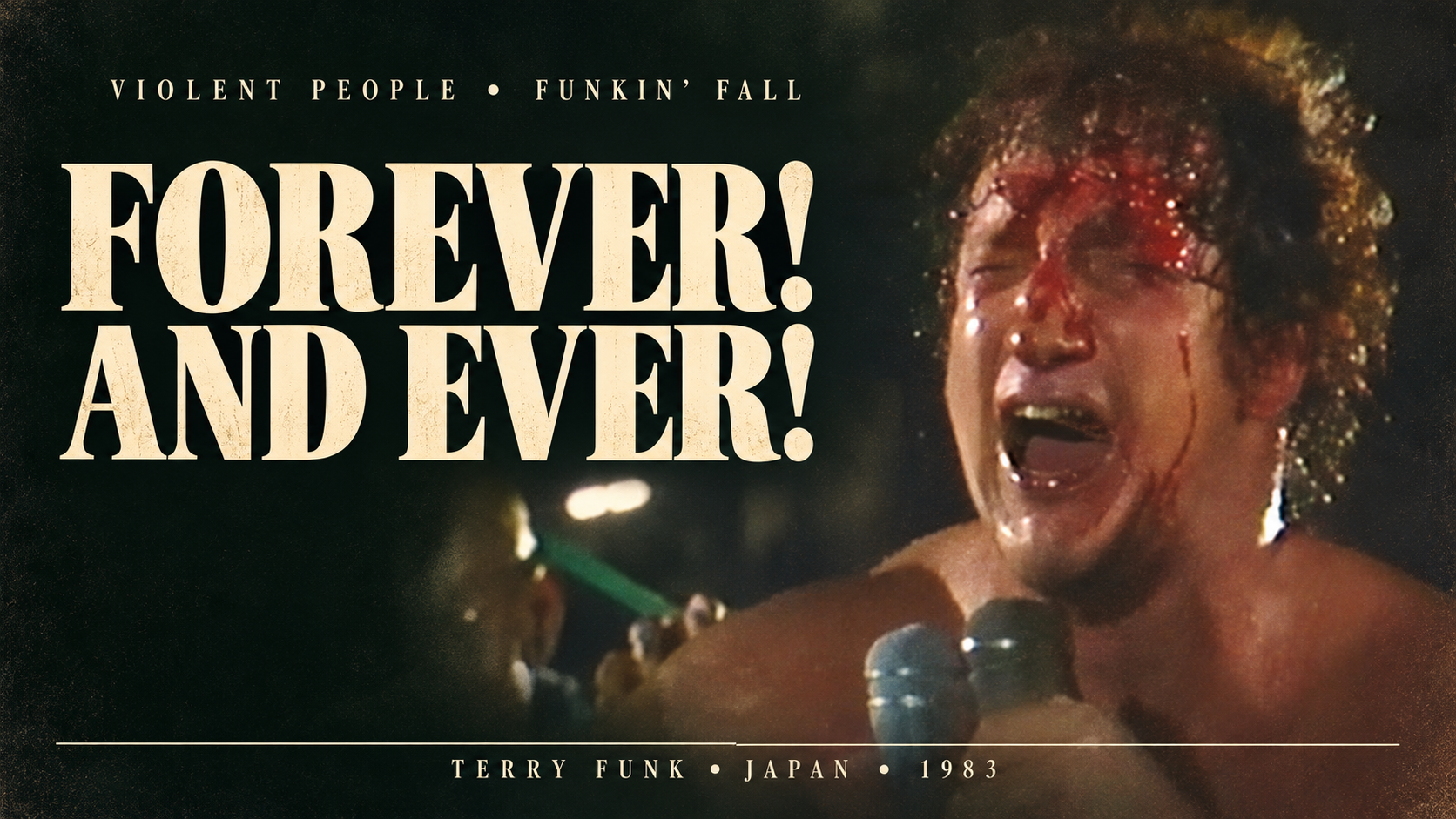
Once order was restored and the ring was cleared, Terry was assisted to his feet. Then, in one of the most memorable post-match moments in wrestling history, the bleeding and sobbing Funk grabbed the microphone, stood beneath the spotlight, and saluted the crowd:
“Japan… number one! Number one! Forever! And ever! Forever! Forever! Forever! Forever! Forever! Forever! Forever! Forever! Sayonara! Goodbye, and I love you!”
Had Terry Funk’s wrestling career truly ceased at this moment, he already would have been responsible for inspiring and shaping the careers of dozens of major wrestlers on multiple continents, either by direct intervention or through the tacit encouragement that came from viewing his extraordinary performances. In actuality, his career was far from over.
The brevity of Funk’s retirement would retroactively transform its protracted leadup and dramatic finish into one of the most anticlimactic events that pro wrestling has ever seen. Regardless, the ripple effect of Terry’s first retirement on the entire Japanese wrestling calendar that was built around it would reverberate throughout the wrestling world for decades to come.
More FUNKIN’ FALL: Explore every year in the series.

- 1983: “Forever! And Ever!” - November 4, 2026
- Le Petit Prince, Le Grand Career: The Hall of Fame Case for Daniel Dubail - November 3, 2026
- 1981: An Audience of None - October 30, 2026