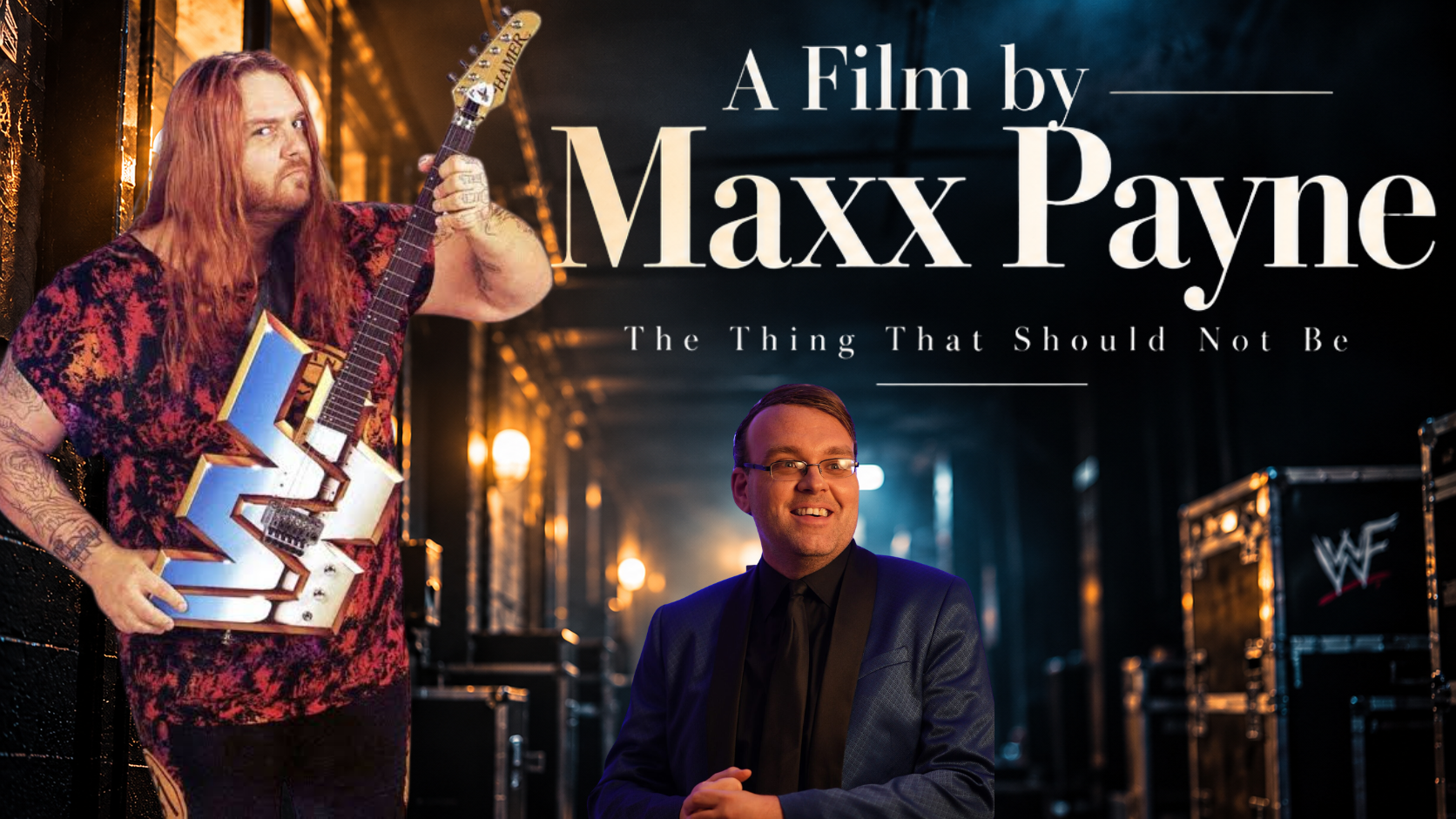
A Film by Maxx Payne

- A Film by Maxx Payne - October 27, 2026
- 1978: Paradise Alley - October 23, 2026
- 1977: Terry Funk Watches Terry Funk - October 21, 2026
Maxx Payne spent thirty-one years waiting to release his infamous WWF backstage footage. With help from Joe Dombrowski, The Thing That Should Not Be is finally seeing the light of day.
In October 1995, Maxx Payne took a video camera on a World Wrestling Federation tour of Europe.
Thirty-one years later, that footage is finally being released.
For anyone like me who spent their childhood mailing money orders to strangers in exchange for increasingly degraded VHS tapes of professional wrestling, the very existence of The Thing That Should Not Be is something of a miracle. There are certain pieces of wrestling footage that have taken on an almost mythical status over the years. Bret Hart vs. Tom Magee. The Last Battle of Atlanta. ANY Hackenschmidt footage.
Maxx Payne’s backstage WWF footage belongs in that conversation, although its reputation comes from a different place. Unlike the others, nobody particularly doubted that the footage existed. Payne had been talking about it for decades. There was a trailer. There were stories. There were rumors about what was captured and why the tapes had never been released.
Everyone knew it was out there. We just never thought we’d actually get to see the damn thing.
Now, thanks to filmmaker and wrestling historian Joe Dombrowski, that’s changing. Dombrowski has worked with Payne to turn the raw footage into The Real Maxx Payne’s The Thing That Should Not Be, a documentary accompanied by an enormous collection of supplementary material.
I spoke with both men about how the project finally came together, the wrestling business they captured in 1995, and the thirty-plus years it took to bring the footage to the public.
You can check out the full conversation on YouTube or as an audio podcast.
During our conversation, Payne revealed something that made me reconsider what I thought this movie was going to be. “There is not one second, not one second of wrestling in this movie,” Payne told me.
Two hours spent with professional wrestlers. Not one second of wrestling. For Payne, that’s the entire point.
The World’s First Wrestling Vlog
Dombrowski first became aware of The Thing That Should Not Be through its trailer, which circulated online more than a decade ago.
The project remained a curiosity until WrestleCon in Dallas in 2022, when circumstances brought Dombrowski and Payne together.
Payne had been down this road before.
“There’s been a lot of horseshit people rolling in and out,” he told me. “Joe’s the first guy that has stuck with me through thick and thin.”
According to Payne, several people had expressed interest in helping release the footage over the years, but none had followed through. Dombrowski was different. He made commitments, followed through on them, and eventually gained Payne’s trust.
Still, Payne insists there was another reason the footage remained unreleased for so long.
He wanted people to wonder.
“I wanted to build the intrigue and the mystery for as long as humanly possible before it did finally come out,” Payne explained.
For more than three decades, that’s exactly what happened.
Meanwhile, the professional wrestling business changed in ways that would have been almost impossible to imagine in 1995.
Today, seemingly every current and retired pro wrestler has a podcast and a YouTube channel. Backstage access is an entire industry. WWE produces a Netflix program specifically designed to show fans the people and personalities behind the characters they watch on television.
In 1995, that world barely existed.
Dombrowski describes Payne’s recordings as “the world’s first vlog,” or, more specifically, wrestling’s first video diary.
Payne traces the inspiration to MTV’s Road Rules. He believed professional wrestlers, removed from the artificial constraints of their television characters, would make fascinating subjects for the same kind of unscripted entertainment.
“Wrestlers … are better at being themselves behind the scenes … than they are at being the characters that they portray on the other side of the curtain,” Payne said.
Rather than simply recording a wrestling tour, he wanted to capture what he calls life on the other side of the curtain. And in what I consider a surprising development, the WWF allowed him to do it.
Vince McMahon Gave His Blessing
Considering the company’s longstanding obsession with controlling its public image, it seems almost unbelievable that a wrestler could have wandered through the locker room filming whatever caught his attention. According to Payne, none of it would have happened without Vince McMahon’s permission.
“This wouldn’t have happened without Vince.”
Maxx Payne
He recalled an encounter with WWF road agent Tony Garea, who initially ordered him to shut off the camera. Payne responded that McMahon had already given him permission. Garea left, apparently to verify the story, and returned without preventing Payne from continuing.
Throughout the recordings, Payne says, agents, referees and wrestlers appear on camera without the kind of resistance one might expect.
There were occasional objections, and Payne maintains that he tried to respect people who didn’t want to participate. But he remembers most of the wrestlers being enthusiastic about the opportunity.
His camera wasn’t merely tolerated. In some cases, it was practically an invitation to perform.
Payne expected that much from the wrestlers. What surprised him was the way people outside the spotlight emerged as some of the documentary’s most interesting characters.
“I didn’t count on Tony Garea being such a star,” he said.
He also singled out German wrestling personality Karsten Schäfer and the ordinarily private Bob Holly as particularly memorable participants.
And that’s part of what makes this footage interesting. We’ve spent decades hearing Kevin Nash and Scott Hall talk about the wrestling business. We haven’t heard nearly as much from people like Garea, especially when they weren’t sitting in front of somebody conducting a formal interview.
The opportunity to watch these people simply exist within the wrestling business may ultimately prove more revealing than another retrospective explanation of backstage politics in the WWF.
The End of Maxx Payne
For all the attention paid to what the footage might reveal about other wrestlers, there’s another story running through The Thing That Should Not Be. Maxx Payne was filming the end of his own WWF career.
“This is me trying to keep my career in the wrestling business,” Payne explained.
He had spent years working toward a sustainable career as a professional wrestler. By October 1995, that career was in serious trouble. Looking back, Payne sees the European tour as the conclusion of something he’d spent much of his adult life trying to build.
“It was the kiss of death,” he said. “It was my blackball.”
Maxx Payne wasn’t an outside filmmaker studying a group of degenerate wrestlers. He was one of them.
Dombrowski understood that distinction. When he first examined the recordings, he found largely unedited material that needed someone to give it a coherent narrative. He also recognized that Payne had spent thirty years imagining what that narrative should be.
Dombrowski couldn’t simply take the footage and make the movie he wanted without considering the intentions of the person who had recorded it.
“Not only is Max the cameraman, not only is he in some respects the subject and the focal point of a number of the scenes, but he is still more emotionally attached to this than any other human being possibly could,” Dombrowski explained.
That meant making room for Payne’s creative decisions, including one that initially gave Dombrowski pause.
The music.
Payne was already envisioning the documentary’s soundtrack before he ever started filming. His band Living Insanity, which included fellow wrestling stars Brian James and Nick Patrick, became a central part of the finished project.
Dombrowski admitted he was initially skeptical about how the music would work with the footage. Once he began experimenting with it, however, he realized how effectively it conveyed the moods and emotions Payne wanted to communicate.
Payne compared Dombrowski’s role to that of a conductor.
“The musicians play the music and the conductors play the musicians.”
It’s a fitting metaphor for a project that required one man to organize thirty years of another man’s creative ambitions into something an audience could actually sit down and watch.
More Than the Kliq
This is the WWF in the mid-nineties, so of course, the elephant in the room is the Kliq.
The reputations of Kevin Nash, Scott Hall and their associates have been intertwined with the mythology surrounding the Payne footage for years. Depending on which accounts you’ve heard, the tapes contain material that might embarrass some of the most influential wrestlers of the period.
Dombrowski acknowledges that those rumors have become increasingly elaborate and exaggerated with time.
He recalled hearing claims that wrestlers had banded together and threatened legal action to prevent the recordings from being released, along with other stories about potentially reputation-damaging material.
When I asked whether anybody had pushed back against the documentary since its announcement, Dombrowski said he hadn’t received objections, threats or criticism from anyone involved.
He also told me that he attempted to contact Nash about participating in a retrospective watch-along.
“I would have loved to have Kevin been a part of this,” Dombrowski said.
Nash did not participate, though Dombrowski didn’t present that as an outright refusal. More importantly, the documentary apparently offers considerably more than material about the wrestling business’s familiar backstage villains.
Dombrowski sought out wrestlers and other personalities who had participated in the tour, recording new interviews and reactions to the old footage.
Shane Douglas, Henry Godwinn, Tony Garea, PCO, Karsten Schäfer and others contribute additional perspectives.
Put those recollections alongside Payne’s personal account, and the documentary becomes more than one man’s interpretation of his own experience.
Dombrowski calls it a time capsule.
“In some ways it’s nostalgic, in some ways it’s cautionary.”
A Few Surprises
One unexpected appearance comes from someone who wasn’t yet a professional wrestler.
British wrestler Johnny Storm appears in the recordings as a young fan hoping to break into the business, even appealing to Vince McMahon for an opportunity.
Dombrowski, who has known Storm for years, didn’t recognize him until he started reviewing the footage.
According to Dombrowski, Storm was remembered by some of the wrestlers as “Lil Razor,” a young fan who dressed like Scott Hall and regularly showed up around the wrestlers with a camera.
Dombrowski subsequently interviewed Storm for the documentary’s bonus features. There are other discoveries as well.
The five-disc edition contains the main documentary, contemporary interviews, additional archival footage and deleted scenes. One extra follows Payne to an appearance with CWA in Hanover, Germany, immediately after his WWF departure.
Dombrowski also incorporated material supplied by fans, including footage of wrestlers arriving at hotels and emerging from the tour bus.
Even more intriguingly, Dombrowski revealed that he and Payne have discussed a possible sequel or prequel using other footage Payne still possesses.
Nothing has been announced, but apparently The Thing That Should Not Be isn’t necessarily the end of the story.
And for the wrestling fans who, like me, spent far too much of their youth accumulating VHS tapes, the documentary is even being issued in that format.
A Film by Maxx Payne
For all the discussions about lost footage, backstage politics and who did what to whom in 1995, the most revealing part of my conversation with Payne came when I asked whether he was nervous about finally releasing the film.
He was, and he wasn’t shy about it.
Not because he expected the wrestling business to come after him, or because he was worried about some terrible revelation buried in the recordings.
He was nervous because he’d spent almost fifty years wanting to make a movie.
As a teenager, Payne appeared in the film Take Down. The experience made an enormous impression on him, and he began dreaming of becoming a filmmaker himself.
Even the simple act of filming the tour presented difficulties. Payne recalled having to carefully consider the cost of batteries and whether he could afford enough of them to keep his camera running. Long before digital cameras made recording practically limitless, Payne was attempting to document the wrestling business while worrying about something as ordinary as running out of power. It’s a small detail, but one that makes the existence of the footage thirty-one years later feel even more remarkable.
He went on to become a professional wrestler, a musician and a recording engineer. But the ambition to make a film never left him.
Now, after thirty-one years of carrying around a documentary that existed largely in his imagination, Payne is finally going to see his name on the screen.
“A film by Maxx Payne.”
“It’s taken me now almost 50 years to accomplish that goal,” he told me.
There’s a vulnerability in Payne’s voice when he discusses this. He knows that some people will make fun of him. Maxx knows that audiences might not interpret everything the way he intended.
He’s also aware that the documentary exposes a younger version of himself, including emotions and experiences that weren’t necessarily pleasant.
There’s another emotional piece to this puzzle.
Many of the people appearing in the recordings are no longer alive.
Owen Hart. Scott Hall. Bam Bam Bigelow. Louie Spicolli. All featured in the documentary. All sadly no longer with us.
“I cry every time I watch it.”
Maxx Payne
Something I hadn’t considered until speaking with Payne was what this footage might mean to their families. For wrestling fans, it’s a chance to see performers we loved in an entirely different light. For their families, it’s an opportunity to see and hear someone they’ve lost, captured in ordinary moments that otherwise might have disappeared forever.
For thirty-one years, the wrestling world has wondered about the scandalous things Maxx Payne might have recorded on that European tour.
Maybe those things are there. Maybe some of the stories will live up to their reputations. Others may turn out to have been greatly exaggerated by decades of speculation.
Perhaps the real significance of The Thing That Should Not Be isn’t that it exposes the wrestling business.
Perhaps it’s that for two hours, in a business where almost everything is a performance, Maxx Payne managed to record a group of conmen who had briefly stopped pretending to be somebody else.
The Real Maxx Payne’s The Thing That Should Not Be is being released through Pro Wrestling Library, with DVD, video-on-demand and limited VHS editions, alongside a soundtrack release featuring music from Living Insanity. More information is available at ProWrestlingLibrary.com.