Giving Thanks for Jumping Joe Savoldi

- Giving Thanks for Jumping Joe Savoldi - November 26, 2026
- 1992: Tequila and Bonetti - November 25, 2026
- Cowboy Bill Watts (1939–2026): The Rich, Full Life of a Bad Guy - November 18, 2026
On Thanksgiving night in 1938, the Washington, D.C., police found themselves in the unenviable position of having to protect professional wrestlers from professional wrestling fans. The object of their hatred was a 305-pound masked wrestler who wore orange ring attire going by name of the Golden Terror.
The Terror had spent much of November antagonizing the patrons of Turner’s Arena. Earlier in the month, Tom Mahoney had nearly succeeded in removing his mask. A week later, the Terror was again at odds with the paying customers. By Thanksgiving, the people of Washington were at a boiling point. Across the ring from The Terror, on that Thanksgiving night was Joe Savoldi.
Savoldi had beaten the Golden Terror, but there was more wrestling to be done that evening. Some of the paying customers decided to participate.
In the following morning’s Washington Post, sportswriter Lewis F. Atchison would report that a riot had narrowly been averted. It wasn’t the first memorable Thanksgiving for Joe Savoldi.

Eight years earlier, Joe Savoldi had been one of the most famous college football players in America.
Born Giuseppe Antonio Savoldi in Castano Primo, Italy, in 1908, he had come to the United States as a child, eventually settling in Three Oaks, Michigan. He would find his way to South Bend, Indiana, where he played football for Knute Rockne.
By 1930, Rockne had become something approaching a national institution. Notre Dame was in the midst of one of the great runs in the history of college athletics, and Savoldi was one of its most recognizable players. Unfortunately for Notre Dame fans, Joe Savoldi had a wife. WOMEN
Savoldi had married while attending the university, in violation of its regulations. When the marriage became public in November 1930, his college football career came to an abrupt end. Notre Dame would finish its season undefeated and claim another national championship.
In 1930, playing pro football was not necessarily the obvious career progression for a great college football player. College football enjoyed a respect and popularity that the young National Football League could only aspire to.
George Halas, the owner of the Chicago Bears, was less concerned with the sanctity of Notre Dame’s regulations than he was with the possibility of putting Joe Savoldi in his backfield.
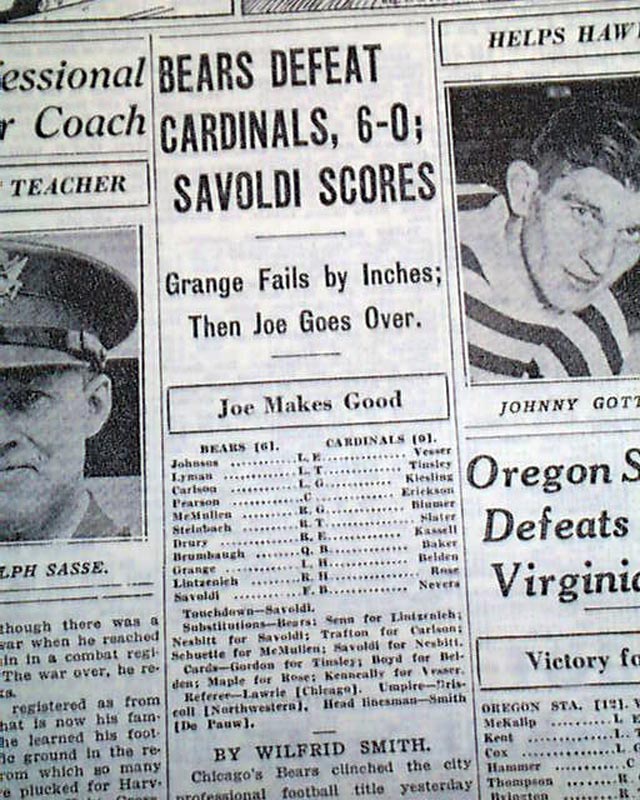
On November 27, 1930, Thanksgiving Day, the Chicago Bears played the Chicago Cardinals before 8,175 spectators. A little more than a week after his departure from Notre Dame, Savoldi was playing professional football.

The Bears won 6–0. Savoldi scored the game’s only touchdown.
The following morning, the Chicago Tribune ran the headline, “Bears Defeat Cardinals, 6–0; Savoldi Scores.”
Wilfrid Smith, the Tribune sportswriter responsible for covering the contest, was also one of the officials. The NFL was a very different level of business in 1930 than it is today.
League president Joe Carr was less enthusiastic about Savoldi’s professional debut than the Chicago sportswriters. The Bears had employed a player whose college class had not yet graduated, and Carr fined the organization $1,000. Joe Savoldi’s professional football career had begun with a victory, a touchdown, and a fine all in one game.
His pro wrestling career would prove remarkably similar. There was a hell of a lot of money to be made as a football player in professional wrestling in the early 1930s. Gus Sonnenberg had helped transform the business with the popularization of the flying tackle. The success of Sonnenberg encouraged promoters to recruit athletes whose celebrity had been established on the gridiron.
Savoldi was wrestling professionally by February 1931. According to a 2019 Philadelphia Inquirer profile, Savoldi earned $3,500 for his professional wrestling debut, a match that lasted thirteen minutes.
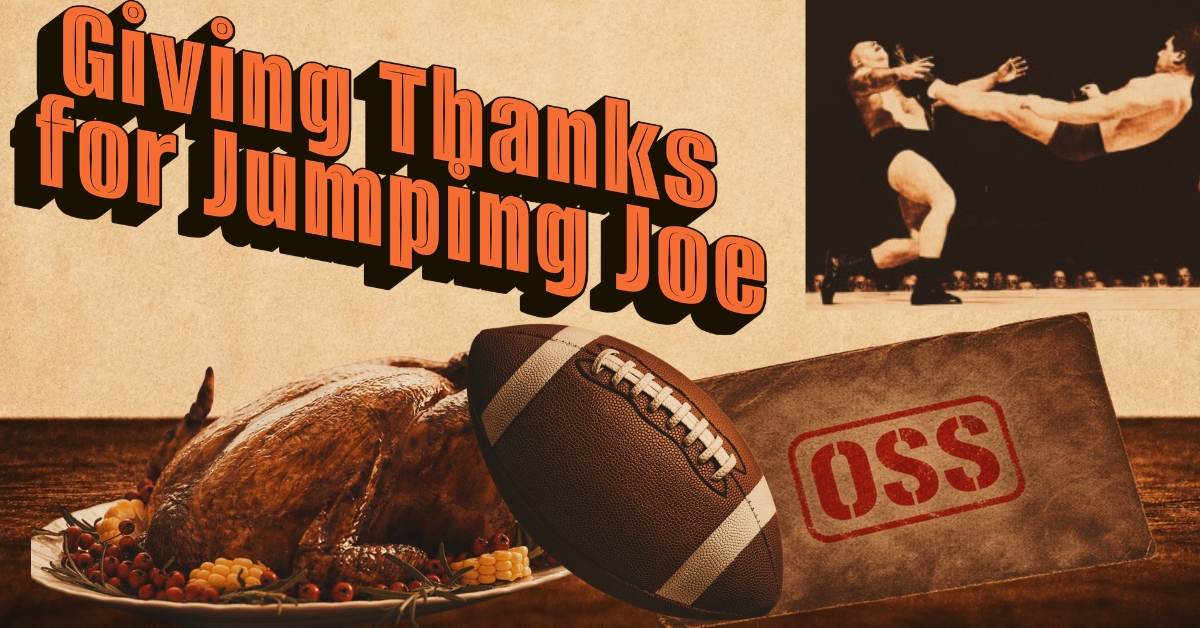
His most enduring contribution to professional wrestling would be a move that we all take for granted now. The dropkick.

There are competing claims to the invention of the dropkick. Abe Coleman, another wrestler of the era, is often credited with developing a similar maneuver after observing kangaroos during a trip to Australia. Establishing which man was the first to leave his feet and kick another man in the chest is both difficult and unnecessary. Joe Savoldi made a great deal of money convincing people to pay to watch him do it. In pro wrestling, that’s really all that counts.
In June 1933, Savoldi wrestled Jim Browning in the rain at Yankee Stadium. The Associated Press felt it necessary to explain Savoldi’s maneuver to its readers, describing it as a relatively new wrestling hold.
Three years later, the Pittsburgh Press was still advertising Savoldi’s dropkick as an attraction unto itself. His opponent that evening, Vic Christy, had a spectacular flying headscissors. The two high flying moves were just as much a part of the promotion as the men themselves. I hate to break it to you, but the people have always loved highspots.
On April 7, 1933, at Chicago Stadium, Joe Savoldi defeated Jim Londos.
Jim Londos’ celebrity and importance are consistently undervalued and forgotten. There have been very few periods in the history of pro wrestling where a wrestler enjoyed the sort of sustained drawing power that Londos possessed in the early 1930s. At a time when millions of Americans were struggling to find employment, thousands of them were regularly willing to part with what little money they had to watch Jim Londos wrestle. If you had to choose between eating and seeing Londos, it legitimately gave you pause.
Londos was a not man who lost a lot of wrestling matches. Twenty-six minutes and twenty seconds into their encounter, referee Bob Managoff awarded the fall to Savoldi. Londos disputed the decision.
The following morning, the Chicago Tribune published an account under the headline:
On the Square or Not? 6,000 Fans Wonder.
I love that headline because it speaks to the relationship that fans had with pro wrestling long before dirtsheets or the internet
The issue was not professional wrestling was legit. The issue was whether this particular finish had been legitimate. Had Savoldi actually beaten Londos? Did Londos agreed to lose? Had the referee participated in a conspiracy? Was Savoldi shootin? Had everybody been working everybody else? Did they work themselves into a shoot?
The Illinois State Athletic Commission intervened, professional wrestling was temporarily suspended in the state, and the National Wrestling Association continued to recognize Londos as champion.
By Thanksgiving 1938, Savoldi was no longer the novelty he had been at the beginning of the decade. His football career was eight years behind him, and he had established himself as a full time pro wrestler.
And on that Thanksgiving night, The Golden Terror was going to wrestle Joe Savoldi.
Lewis F. Atchison began his account of the proceedings in the following morning’s Washington Post: Ham, rather than the customary gobbler, was the holiday offering at Turner’s Arena last night
That’s the seriousness that newspapers treated pro wrestling at this point.
Also appearing at Turner’s Arena that Thanksgiving was Frank Simmons Leavitt, better known to wrestling fans as Man Mountain Dean.
Dean and Savoldi weren’t strangers. The two had wrestled one another in Los Angeles in 1934, and footage of one of their encounters has survived. Watch the footage of Dean and Savoldi from 1934 and tell me how much pro wrestling has really changed. Big vs little, strong vs fast. etc
Two weeks before Savoldi wrestled the Golden Terror, synagogues, businesses, and homes belonging to Jewish people had been destroyed throughout Germany and Austria during the Nazi pogrom that became known as Kristallnacht.
The November 1938 newspapers I’ve been reading for this piece make for some pretty uncomfortable reading once you get away from the sports pages.
The following September, Germany invaded Poland. In December 1941, the United States entered the Second World War. In 1942, Joe Savoldi was approached by the American intelligence community.
More specifically The Office of Strategic Services, the wartime intelligence agency that would eventually lead to the Central Intelligence Agency.
Among the. Americans recruited were actor Sterling Hayden, Major League Baseball catcher Moe Berg, and a professional wrestler who had once been responsible for the suspension of professional wrestling in Illinois.
The OSS had plenty of reasons to be interested in Savoldi. He knew Italy, spoke several of its dialects, and was considerably better equipped than most Americans to handle himself in a fight.
He was recruited into the Special Operations Branch of the OSS and assigned the code name Sampson.
There is a wonderful anecdote in historian John Whiteclay Chambers’ account of OSS training at Catoctin Mountain Park in Maryland. During a combat training exercise, instructor Jerry Sage found himself on the receiving end of a flying scissors. Sage knew his student only by the name Vic and was understandably curious as to where the man had learned such an unusual proficiency in throwing people to the ground with his legs. Savoldi had to explain that he was a pro wrestler.
A surviving OSS memorandum, now housed in the Hoover Institution’s archives, identifies Savoldi as a civilian who formally entered the organization on July 7, 1943. Four days later, he arrived in North Africa.
For his services to the United States government, Savoldi was receiving $400 a month, in addition to a daily expense allowance of seven dollars.
Considering what professional wrestling had been paying him, the US government was getting Joe Savoldi at a pretty steep discount.
Savoldi was assigned to an operation known as the McGregor Mission. His fellow operatives included Lieutenant John Shaheen, Henry Ringling North, a member of the famous circus family, and Michael Burke, a former college football player who would eventually become president of the New York Yankees.
Burke would later recall that Savoldi “was built like a gorilla and moved as lightly as a leopard.”
The initial goal of the McGregor Mission was to facilitate the surrender of the Italian naval fleet. An Italian businessman living in America, Marcello Girosi, had a brother who was an admiral in the Italian navy. The Americans hoped one brother could convince the other to turn against the Germans. Savoldi had been assigned to protect Girosi.
Meanwhile, back in America, Savoldi’s wife, Lois, was trying to get a letter to her husband.
On August 9, 1943, she wrote to R. Davis Halliwell, an official in the OSS’s Special Operations Branch. Savoldi had been away for nearly seven weeks, and although she had been writing to him almost daily, he had received no letters from home.
According to the Philadelphia Inquirer’s subsequent reporting, Lois would not fully appreciate the nature of her husband’s wartime work until the publication of Michael Burke’s memoir in 1984.
Joe had been dead for ten years.
By the time the McGregor Mission was fully underway, Benito Mussolini had been removed from power. In September, the Italian government announced its armistice with the Allies. Germany responded by occupying much of the country.
For the men of the McGregor Mission, the changing relationship between Italy and Germany meant a change of plans. They were now going after Italian military officers and scientists who had any information of value to the Allies.
One of those men was Professor Carlo Calosi. Calosi had been instrumental in the development of an Italian torpedo capable of detonating beneath a ship rather than striking its hull directly. Calosi knew how these weapons worked, and the Americans wanted to know how to defend against them.
The Germans occupied Rome, where Calosi was thought to be hiding. In September 1943, Savoldi had already experienced the realities of the Italian campaign at Salerno. The McGregor team had endured German shelling, and much of its equipment had been lost.
Savoldi later recalled that the Germans had left him little more than his toothbrush and toothpaste.
Through contacts in the Italian underground, the Americans eventually located Calosi. He had taken refuge in a convent. On Christmas Day 1943, with Calosi disguised as a priest, they began their journey out of German-occupied territory.
In early January 1944, Savoldi and his fellow operatives helped bring Calosi and a group of Italian military to safety. Within weeks, Calosi was providing American representatives with information about Italian naval weapons.
I don’t know how many American lives the McGregor Mission saved, or how much of the credit belongs to Joe Savoldi indivually. I suspect nobody does, but the National Park Service’s official history of the OSS identifies the acquisition of information about Axis weapons as a significant intelligence achievement.
Joe Savoldi would remain in Italy after the mission.
The surviving OSS memorandum records that Savoldi was subsequently placed in charge of a training school and later held a position overseeing operations in the Naples area.
Among his assignments was investigating the city’s black market. Naples had been liberated, but its people were still starving. American military supplies were doing big business on the black market.
Savoldi went undercover. A surviving identification document shows he used the name Giuseppe De Leo.

Joe Savoldi wasn’t even the only wrestler at Turner’s Arena on Thanksgiving night in 1938 who would contribute to American military intelligence.
Man Mountain Dean, the big nan who had appeared on the undercard that evening, would serve at the Military Intelligence Training Center at Camp Ritchie, Maryland.
Among the men trained at Camp Ritchie were German-speaking Jewish refugees who had fled Nazi persecution and returned to Europe as American soldiers. They became known as the Ritchie Boys.
On December 22, 1944, Savoldi received a memorandum informing him that his employment with the OSS would be terminated in thirty days.
In January 1945, with the war in Europe still ongoing, Joe Savoldi returned to professional wrestling.
United Press sportswriter Jack Cuddy interviewed him ahead of his return to the ring in Philadelphia. Cuddy wanted to know whether Savoldi had been discharged from the Army.
Savoldi explained that he hadn’t been in the Army.
What, then, had he been doing?
“Let’s just say I was working for the government on special assignment.”

In May 1945, YANK, the United States Army’s weekly magazine, featured Savoldi. Accompanying the article was a photograph of him delivering his famous dropkick to George Zaharias..
By the end of the year, the American public would begin to learn what Jumping Joe had been doing during his absence.
Corey Ford and Alastair MacBain, both veterans of the OSS, chronicled the activities of American operatives in their book Cloak and Dagger: The Secret Story of the OSS. An entire chapter was devoted to the exploits of the former Notre Dame fullback.
The book was adapted into a 1946 film of the same name, directed by Fritz Lang and starring Gary Cooper. Michael Burke served as a technical adviser.
Savoldi would continue wrestling after the war. He helped launch the career of Bobo Brazil.
In his fifties, Savoldi returned to college to complete his education. He eventually became a teacher in Henderson, Kentucky. Savoldi died in January 1974, at the age of 65.