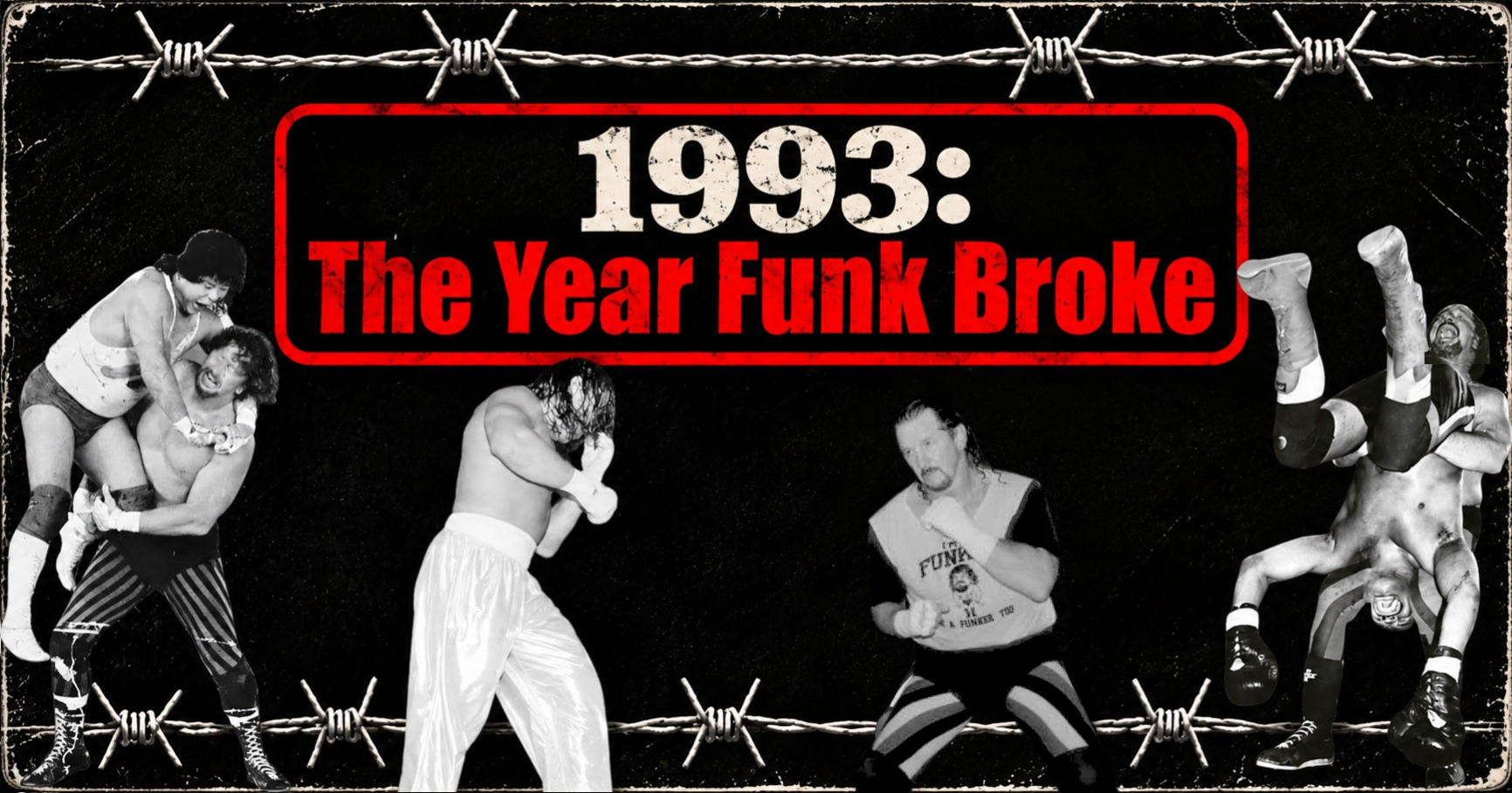
1993: The Year Funk Broke
Written by Chris Colvin
Part of Violent People’s FUNKIN’ FALL series: View the full index.
In 1993, I graduated high school, moved out of my parents’ house and in with my girlfriend and her infant daughter, lost a job working nights at a grocery store, moved out of my girlfriend’s house, moved back in with my parents, found a job at a steel factory, moved back in with my girlfriend and ultimately contemplated taking my own life. It was a tumultuous year, to say the least.
In 1993, Terry Funk was in his 49th year on Planet Earth, he wrestled Eddie Gilbert in Eastern Championship Wrestling in January, and defeated Sabu for the ECW title at the end of December of the same year. In between, he competed in a Texas Chain Match, a Different Style Fight Match, a Tag Team Stretcher Match, fought Carlos Colon in Puerto Rico, ran a produce show in Amarillo, wrestled both the Sheik and Abdullah the Butcher and, oh yeah, he was one of the two participants in what may be the greatest spectacle match in professional wrestling history: the No Rope Barbed Wire Current Blast Super Large Time Bomb Death Match against Atsushi Onita. It was a tumultuous year, to say the least.
By 1993, Funk was in his 28th year as a professional. When you see what he accomplishes in this year, that fact becomes more insane to think about. I am in my 12th year of employment doing the same thing for the same employer and I cannot imagine making it another 16 AND being in peak form when that happens. But that is what Terry did. 1993 was his watershed year for most fans my age. Sure, hardcore fans knew of Funk prior to the 1989 angle with Flair, but that angle and the lore it created, coupled with how his 1993 unravels, are what cement his status as the legend he eventually becomes.
I remember reading about Terry’s exploits overseas in FMW and IWA as a ‘deathmatch’ wrestler. Back then, deathmatch wrestling was the most punk rock form of the sport as it existed. I contend that may not be the open-and-shut case it was then 33 years later. As someone who has spent the majority of his life relating to and taking part in the punk scene, I can attest that things have changed a little bit. In today’s iteration of what true punk rock means, shoot-style wrestling is probably its closest analog while deathmatches are more like the punk rock that is safe for radio. I mean, AEW thinks nothing of using cinder blocks and syringes for Christ’s sake. But when was the last time you saw two wrestlers face off in a match based on who has the better Gaminguri or Kimura lock on national television? To find that shit, you need to dig in the crates and look in the dark, dank corners of Japanese basement venues and American Legion halls. I firmly believe that if Funk were in his prime today, he would not only take glee in driving a dozen skewers into his opponent’s skull but he would also enjoy testing his mettle in matches where the only time he leaves his feet is to deliver a double-leg takedown and lock on the armbar. Terry Funk was punk as fuck, and never forget what D. Boon said: ‘Punk is whatever we make it to be.’ In 1993, Terry Funk made pro wrestling whatever he wanted it to be.
Eight months or so prior to his final match in ECW, Eddie Gilbert was embroiled in a feud with Terry Funk. A feud that was a story as old as time; the young, spry leader of the pack taking umbrage with the attention given to the more experienced, new member of the pack who is simply looking for a place to ply their trade. There are countless examples of this type of struggle for dominance playing out in nature. Young bears are especially guilty of this and it typically does not end well for them. See, age may slow you down, but experience creates callouses that toughen the hide. I remember learning this firsthand at 16 when my hormones were working overtime and I had finally had enough of my dad telling me what to do. In reality, he was simply asking me to do my part on our small farm, but my testosterone-addled brain couldn’t allow this any longer. I won’t bore you with the details or add to my childhood trauma with the details, but needless to say, I carried my weight plus some around there for the remainder of my time living in his home.
Much like me, Eddie had a lesson to learn about challenging an elder. These two had crossed paths in various territories before and Gilbert is the definition of cockshure. Funk doesn’t lack in the confidence department either. After a series of confrontations where Eddie would use the bully pulpit to insult Funk, our hero had finally had enough and decided to not let words do what fists could more succinctly communicate. This resulted in the first match in our recap Eddie Gilbert vs. Terry Funk in an I Quit Texas Death Match on January 23, 1993.
January 23, 1993
Opinions of this match are seemingly all over the place. I checked the Cagematch page for it and the overall rating of 7.12 is probably fair from a historical perspective. This is an absolute slugfest featuring a lot of work outside the ring. The quality of the footage I saw was actually very good for the fan cam shot video from the day. The feud delivers in a much bigger way down the road in 1993 and Terry has many better matches in him during this period, but I do not feel this is a waste of time to watch especially as a microcosm of ECW at this moment in time.
For my money, there isn’t a wrestler alive who could deliver a punch or sell a punch at the level of Terry Funk. But, the more I watch Eddie, the more respect I have for his talent at the exact same thing. This is what makes the match so enjoyable to me. Boiling down professional wrestling to punches, kicks, nerve holds, submission attempts and storytelling really touch my fandom in its core. Something as simple as Funk’s patented spinning toe hold is delivered here with such urgency. The use of the plunder of the day, mainly tables and chairs are kept at enough of a minimum to not overstay its welcome.
There is blood spilled and it does the job of enhancing the violence. I only wish I had a better version of this recording in order to really see the blood fly with each slap of the face and punch to the skull. The final act contains Eddie’s last attempt to best his foe. The use of a fireball to Funk’s face should probably have finished the match, but Funk is not any normal pro wrestler, even in 1993 he could stake a claim as the toughest SOB on god’s green earth.
A quick, self indulgent aside, the carpet of the ballroom inside the Radisson looks so similar to the type of flooring that my grandmother covered her entire home in. And because my favorite place on Earth yesterday, today and forever will be her house, my heart was warmed as I watched Eddie and Terry spill blood all over it. Yes, the pattern may cause seizures today, but that shit was nice back in the 80’s-90’s. And durable too.
‘Are you god damned crazy?’ is the refrain heard in the poorly mic’d audio of the video I watched. The words uttered by Terry toward his enemy are haunting even 33 years later. What follows is pure violence. The ring steps are driven into Eddie’s trapped leg until the match is finally called for Funk. What a beating Gilbert took and the victor didn’t look much better at the end of this. This is a great study and blueprint for a match type that has mostly worn out its welcome.
May 5, 1993
Terry spent the majority of the middle of 1993 in the promotion Atsushi Onita built, Frontier Martial Arts based out of Tokyo, Japan. Onita’s idea for his promotion was to push the limits of how big the spectacle and theater of pro wrestling could be.
And this match was as BIG as it could get. The show itself is an FMW Anniversary show emanating from the Kawasaki Stadium in Kawasaki, Japan in front of a packed house of 52,100. The majority of attendees came, almost assuredly for the word salad main event of Atsushi Onita vs. Terry Funk in a No Rope Barbed Wire Current Blast Super Large Time Bomb Death Match.
The premise of the match is that after a set amount of time, the ring would explode. Oh, and the ropes were replaced with barbed wire and had electric charges loaded into them. The match premise feels like something I would have dreamt up in my formative years playing with my LJN figures on my makeshift wrestling ring that I fashioned out of rubber bands, cardboard and pieces and parts from my collection of various G.I. Joe vehicles.
The shot of this stadium to open the match is so damn cool. They packed every corner of that place with bodies. This had to be a huge payday for the yakuza in cahoots with FMW. A match of this magnitude is absolutely wild when you think it is the first and only singles match. That, to me, is the wrestling equivalent of Nirvana writing, recording and releasing Nevermind as their one and only album. So, what we are left with is an incredible spectacle for the entirety of the match. The barbed wire ring, the space-age beekeeper outfit the referee is decked out in, the aforementioned gargantuan crowd and Onita’s bad ass jacket (someone make a bootleg in XL) create an environment custom made for a historically significant moment. Now, let’s add a countdown clock to the suspense telling the audience precisely when the ring turns from calamity to chaos and you have a perfect match.
You have seen this match if you are taking the time to read this. So, I won’t go moment by moment. I will, however, pontificate briefly about two moments that, not unlike foreplay, lead to the explosive climax.
Probably my favorite moment of the match is a very simple camera shot of Onita staring at his fingers that have been ripped to shreds by a barbed wire spot. There is a realization on his face of where his life’s path has brought him to. Everything in his life led to that moment. Failure in the big Japanese promotions, living in the shadow of the Four Pillars of Heaven and ultimately the deal with the devil he made with an organized crime syndicate were all responsible for how mangled his hands look. That moment is a version of what a moving, climactic scene in a movie tends to make me feel. Great directors will focus on a well developed character, turn the camera on and shut the fuck up. In Boogie Nights, Mark Wahlberg is Onita as his life flashes before him during their attempt to rob a wealthy junkie. The use of the camera and Wahlberg’s ability to emote with his facial expression and eye movement make this scene unequivocally my favorite scene in any film I have ever seen. Cut to the end of the tape where the camera closes in on a reflective Onita in the locker room and tell me you are not moved.
My other favorite moment is more light hearted and one that I never paid much attention to until I heard JR. Goldberg brings it up on a podcast. It is when Funk hilariously goes for a spinning toe hold on Onita as the clock is counting down to one minute. It is like the muscle memory of all his years in the ring fighting all over the world took over his logical brain. Instead of fighting for his life and trying to achieve a flash pin, he drops Onita and begins to twist his foot. In hindsight, it is as funny as it is poignant. It is funny because of the seriousness of the situation and his Wile E. Coyote attempts at a final gasp. It is poignant because it shows me what Funk must have been taught growing up in a wrestling ring; when all else fails, go back to your basics.
This is the epitome of punk rock pro wrestling on a massive stage. This is Rage Against the Machine opening the Lollapallooza Tour in the noon slot during the same year, violent and perfectly placed. Terry Funk is only matched by Onita in the category of true punk rock pro wrestlers.
December 28, 1993
Terry is closing out his year in raucous style with a match for the ECW Championship versus Sabu. This is not the first meeting between these two and it is far from their most famous. I do feel, though, that this is a great preamble to what the promotion and feud would become. .
These two throw everything into this match. Tables, chairs, outside interference and the not as common then as today, ref bump. It is a match where there is no time to breathe. On the surface, it is fun, but messy. Sabu is in his truly suicidal phase here as he leaps all over the ring and outside the ring in spots that were awe inspiring at the time.
The use of an editor would have been helpful here. The work itself is great, as one would expect from Sabu and Funk. But, there is incessant interference from Paul Heyman, Shane Douglas and Sherry. Somewhere in the muck there lies a truly compelling match. It just gets drowned out by the noise of the interference.
Sabu looks phenomenal here as he is honing and perfecting his high flying, violent attack. He uses his Air Sabu to perfection. He lands an incredibly smooth shooting star press to the outside of the ring landing in the front row.
Funk does what Funk does. He punches with purpose. He does his punch drunk act perfectly. As the eventual winner in a bit of schmoz finish you can see the makings of a great match. We are unfortunately robbed of that by the booking of the day which would only become more frustrating as we turn the calendar to 1994.
Funk is eventually given the win after Shane Douglas rolls him onto the prone body of Sabu. It is not a win that Funk should be proud of, but the title is his for now.
Conclusion
Terry Funk is the greatest wrestler of all time, in my opinion. There is no one in the history of the sport who carried the resume he did. Nothing was beyond his abilities inside the ring. No one could make you feel what you were supposed to feel like Terry Funk. His work in 1993 shows such breadth of ability. Yes, the majority of his year he was in his ‘hardcore era’, but the year as a whole is a great study of who he was as his career was seemingly in its twilight. Of course with hindsight, we know he was nowhere near finished and there was a lot of gas left in his tank.
More FUNKIN’ FALL: See every year in the series

- 1993: The Year Funk Broke - November 27, 2026
- Giving Thanks for Jumping Joe Savoldi - November 26, 2026
- 1992: Tequila and Bonetti - November 25, 2026