1992: Tequila and Bonetti
Written by Jon
Part of Violent People’s FUNKIN’ FALL series: View the full index.
1992 is an odd year in American pro wrestling. WWF starts the year with the now legendary Ric Flair title win in the Royal Rumble. The company that “took wrestling mainstream,” and “brought it out of smoky bingo halls,” riding a wave of glamor and hipness otherwise inconceivable to the con men and dullards that had too long guided the industry, looking out over its near stranglehold on the industry, the riches of presenting such a modern and forward-thinking product, decides the next step forward will be paved by the longtime champion of their Southern rivals. WCW has removed itself from the NWA, fires the man that drove Flair out of the company, and seems firmly dedicated to pushing new stars, until, of course, they change their minds about this approach. Nobody has ever accused this industry of making sense.
It is chaotic, but the safest type of chaos imaginable. Is there space here for the “middle-aged and crazy” Terry Funk? Can either company use blood and brawling to get over the toughness of their new stars?
Well, we won’t know. Terry Funk is busy in 1992. The pride of Cokeburg, Pennsylvania, Donald Bellisario, is riding high on the success of Quantum Leap, the latest in a string of hit television shows he has developed, and is eager to find America’s next fascist TV icon. He’s spent the previous decade wowing television audiences with the savviness, the fortitude, and, of course, the stunning good looks ex-military men bring to the civilian world, so now it is time to bring the war home and show the lighter side of our domestic agents of state violence. It’s 1991, going on 1992, and Americans are hungry for more footage of their favorite ultra-violent organized criminal enterprise, the Los Angeles Police Department. And if recent events have put a damper on the use and excitement for raw footage of our favorite fascists at work, leave it to Don Bellisario to realize their star potential in the American sitcom. Fascism has never met a banality in which it cannot excel.
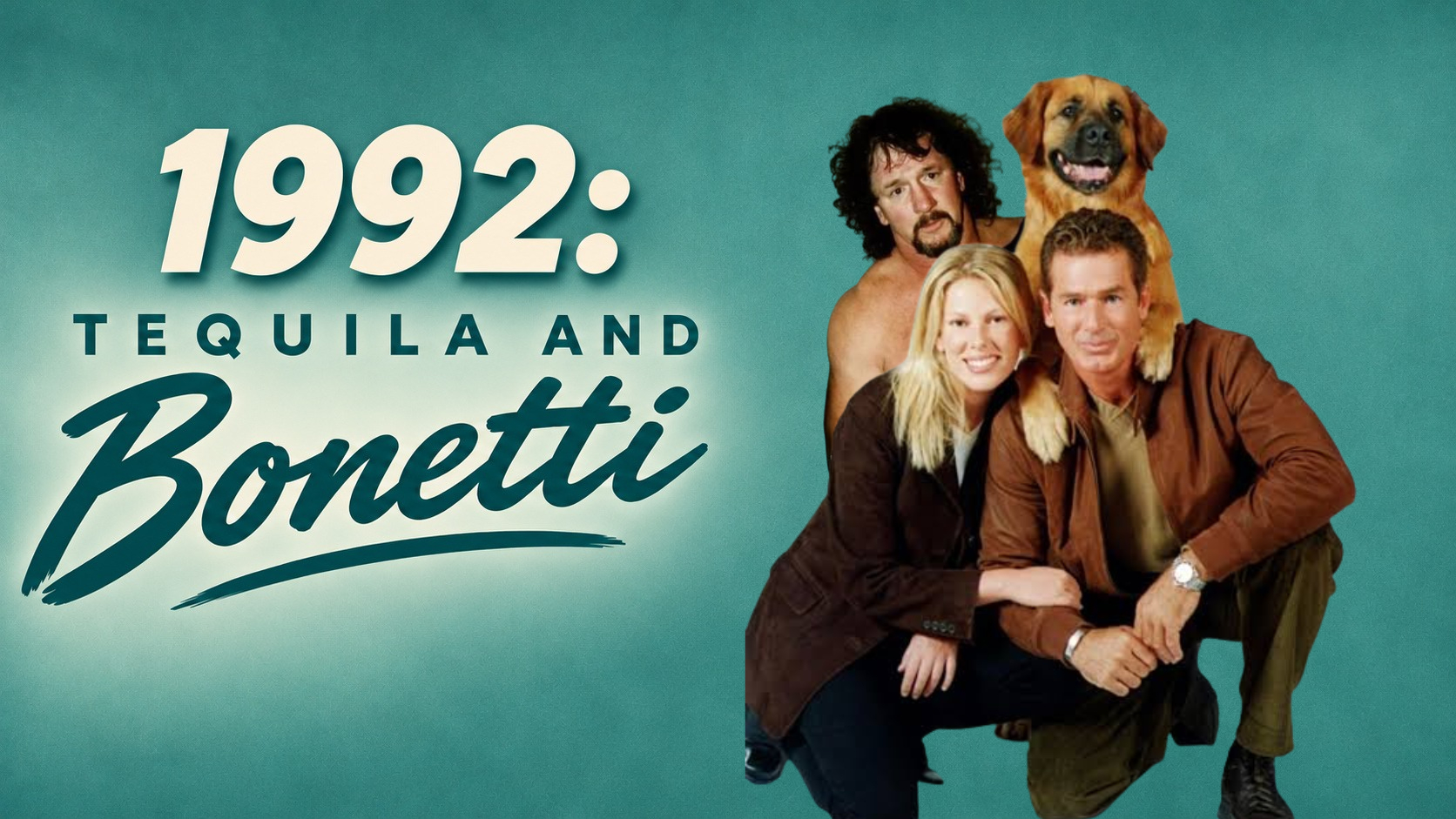
Tequila and Bonetti is just this banality. A sitcom so terrible it has escaped the cancerous nostalgia industry which makes up such an oversized portion of our media. Terry Funk plays Sgt. Nuzo, presumably the titular Bonetti’s superior at the LAPD, and likely a source of bureaucratic frustration as well. Or maybe he’s a bumbling clown with Funk’s large nose and Texas drawl played for laughs. Reader, I am never going to find out. If this is not the absolute worst sitcom the wretched industry has ever devised, then this industry is even more malignant and sinister than I had imagined. A read-through of the Wikipedia entry and then 15 seconds spent watching the intro are enough to reveal this as being dreck beyond parody. The lack of access to the show makes me question the validity of some of the clips I am watching (although it seems like entire episodes and maybe the entire series are easily available on YouTube in Italian dubs), but maybe the show did make the bold choice of not including a laugh track, so that the viewer is forced to sit in silence and wonder about the role they play in a society degenerate and apocalyptic enough to spend energy and resources to create this monument to our worst, hoping that your own participation is so minor, so coerced, even, that the liberations of tomorrow will have some pity, some understanding of your cowardice in the face of the naked evil, or, better even, to pass over your role, your entire existence and participation in this rancid economy of waste, and see you as so insignificant a player that to call your attention inward, to cause you to painfully reflect on your collaborations, is not worth the time it would take to rebuild the empty husk even a brief contemplation would render. Or, perhaps, Mr. Bellisario thought this show, the show with the jive-talking mastiff, was too heavy a vehicle, too willing to approach the very real blemishes of society that our evening television viewer is too quick and too happy to omit from their attentions, and so, this show, still the show with the jive-talking mastiff (who also eats burritos, as Wikipedia lists another important character trait), forgoes that audio-stamp of inauthenticity. Again, I will never know. This show is bad.
The show, a mid-season replacement, is cancelled before the end of its first season. The pro-wrestling industry is flailing and desperately looking for a solid direction. In the United States, two major companies have emerged from the territory wars of the past decade. Ironically, both arrive without a firm sense of direction, survivors more than victors. Could they use the help of one of the savviest workers the industry has produced? A wrestler that has shown the ability to constantly adapt and evolve to stay relevant? In Japan, business was booming. All Japan recently introduced the Triple Crown and was firmly behind the ascent of the 4 Pillars as pro wrestling’s newest stars. New Japan was finding similar success with the 3 Musketeers. Their focus on the future seems to have already left the former NWA champion in the past.
Terry Funk had two matches in 1992. In July, he wrestled in Austria for Otto Wanz’s CWA, losing a title challenge against Rambo, the promotion’s frequent champion. In November, Terry Funk wrestled Eddie Gilbert in a Texas Death Match in front of 300 or so people in a high school gym in Wayne, NJ.
Gilbert and Funk would continue this feud into the early days of ECW, but here they are six months earlier, bleeding and potatoing each other for the delight of a couple hundred people and a video camera. I don’t know why this was recorded via handheld video camera. It’s far too crude for any hope of a television broadcast, yet the recorder is given free rein of the gymnasium and does not attempt to hide their presence. Did they know they were establishing the business model of independent wrestling for the next 30 years? Did Funk and Gilbert realize they could achieve a degree of fame and credibility across the industry while they are terrorizing each other in front of a crowd small enough to fit on one page of a phone book?
Terry Funk is professional wrestling. No other single individual has pushed the artform of pro wrestling the way he has, with this constant innovation and dedication to presenting every single minute action, even actions that seem involuntary or coincidental, as actually belonging to the shared belief that is fundamental to this artform, and not as a preparation for the next piece of the performance or otherwise pausing the reality of the performance. He makes pro wrestling real, without leaving the artform behind. This is why his performance in front of these 300 people is just as authentic and dangerous as when he performs in an arena of thousands or a PPV audience around the world. American pro wrestling in 1992 is quickly coalescing into a singular vision of the art, a vision defined by television aesthetics and a demand for replication. The variety of pro wrestling styles previously available around the country has quickly contracted into two house styles, driven more by television cues and instant replays than by the organic reaction of a crowd. Styles moving towards replication and tropes, and away from the improvisations that are at the base of the artform. At the same time, Terry Funk is performing in front of a camera in this match, but he is never performing for the camera. Terry Funk is showing that the artform of pro wrestling can still live on, even if the economic support for the art form performing in your town every other week no longer exists. It may have been an amazing coincidence that the internet grew just in time to support this much smaller industry that was still interested in the art of pro wrestling, but it is an even bigger coincidence that an artist at the level of Terry Funk was there to keep the art form alive. The early 1990s could easily have seen the death of pro wrestling in America, both as an industry and especially as an art form that evolves and values creativity and enthusiasm, but Terry Funk was there to use his creativity, his dedication to the craft, and his stardom and eminence to present an alternative to the increasingly sterile mainstream. I don’t think that this one match in front of 300 people in Wayne, NJ saved pro wrestling, but its existence shows how Terry Funk saved pro wrestling, and why he is the best to have ever done it.
More FUNKIN’ FALL: See every year in the series

- 1992: Tequila and Bonetti - November 25, 2026
- Cowboy Bill Watts (1939–2026): The Rich, Full Life of a Bad Guy - November 18, 2026
- 1988: Hollywood, Baseball Stadiums, and Bloody Streamers - November 16, 2026