Cowboy Bill Watts (1939–2026): The Rich, Full Life of a Bad Guy

- Cowboy Bill Watts (1939–2026): The Rich, Full Life of a Bad Guy - November 18, 2026
- 1988: Hollywood, Baseball Stadiums, and Bloody Streamers - November 16, 2026
- 1985: Ozymandias and Moondog Spot - November 9, 2026
Bill Watts believed professional wrestling should be taken seriously. The punches should look like they hurt. The rules should matter. The wrestlers should behave like men engaged in a legitimate fight, even when everyone in the building knew they weren’t. If somebody betrayed his friend, the betrayal should mean something. If somebody broke a rule, there should be a consequence. And if the audience hated somebody badly enough, they should be willing to pay money to see him get his ass kicked.
Watts understood all of this better than almost anybody who ever worked in professional wrestling.
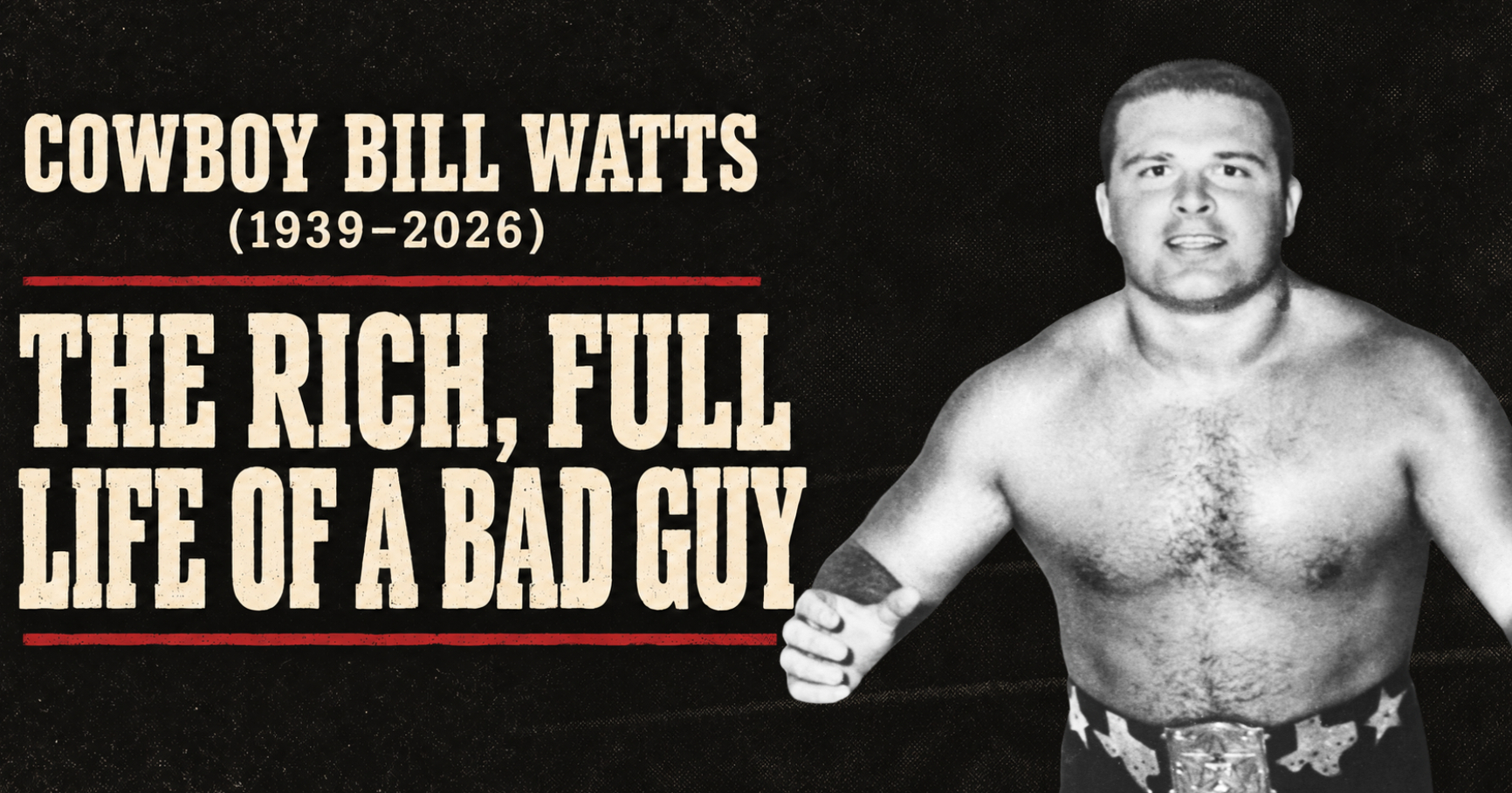
William F. “Cowboy Bill” Watts Jr. died on November 17, 2026. He was 87.
There is no intellectually honest way to write about Bill Watts without addressing his racism. It needs to be confronted and not excused because he made money promoting Black wrestlers.
Watts’ defenders have long pointed to Ernie Ladd, Junkyard Dog, and Ron Simmons as proof that he couldn’t possibly have been racist. “He’s got Black friends!” they shout into the void.
There are easier men to eulogize, and far easier men to admire. Bill Watts was a racist asshole who understood professional wrestling better than almost anyone who ever lived.
Bill Watts Wasn’t a Cowboy
Let’s start off with the obvious stolen valor. The thing about Cowboy Bill Watts is that he wasn’t actually a cowboy. He was a football player from Oklahoma, a very large, very angry football player.
Born May 5, 1939, in Oklahoma City, Watts grew up in a fractured home. His parents separated, his relationship with his mother was troubled, and his adolescence was defined by athletic brilliance and a violent temper (the makings of a great football player).
At Putnam City High School, he became a standout lineman and earned a scholarship to the University of Oklahoma under Bud Wilkinson, no small feat in a state where Sooner football occupied a position somewhere between God and country.
Watts was big, strong, quick for his size, and apparently incapable of going very long without getting into a fight. In his autobiography, The Cowboy and the Cross, Watts recounts an extraordinary collection of brawls and confrontations. In one particularly crazy episode, he described biting off part of another man’s ear during a fight and admitted he had been trying to do considerably worse.
Watts later presented these stories through the lens of his Christian conversion, describing his younger self as violent and self-destructive. Yet an unmistakable pride still bled through. He was ashamed of what he had done, or at least understood that he was supposed to be, but he also wanted you to know how big and tough he had been.
After a brief brush with professional football, Watts found more reliable money in wrestling. By the early 1960s, he was working for Verne Gagne’s American Wrestling Association, learning a trade where his size, athletic background, and legitimate fighting reputation were truly appreciated.
When he reached the Northeast to work for Vince McMahon Sr. and Toots Mondt, the promoters decided the big Oklahoman ought to be a cowboy. Watts later recalled buying a Stetson because he needed the right wardrobe for the gimmick. The Cowboy, in all likelihood, purchased his first trademark hat from a Yankee.
At first, Watts was a hero. By 1964, wrestling magazines were touting him as a rising young star. In Pittsburgh, he survived a bloody beating from Gorilla Monsoon that the press framed as proof of his toughness. In Baltimore, he was already being mentioned as championship material.
His most important work of that period came alongside Bruno Sammartino.
The Rich, Full Life of a Bad Guy
On January 25, 1965, Sammartino and Watts faced Gene Kiniski and Waldo Von Erich at Madison Square Garden. During the match, Sammartino accidentally caught Watts with a dropkick.
Watts turned on Sammartino, and the people of the Northeast responded by wanting to see Bruno murder him. Wrestling magazines presented the betrayal as resentment over playing second fiddle to the champion, which wasn’t a particularly difficult motivation to believe coming from Bill Watts.
On February 22, Sammartino and Watts drew 19,101 fans to Madison Square Garden. On March 29, the announced attendance reached 19,614, a new Garden wrestling record. Their feud continued across the Northeast, including a bloody Baltimore encounter stopped by a ringside physician.
By the end of 1965, Watts had become enough of a cultural curiosity that The Saturday Evening Post dispatched Myron Cope to profile him. Most people remember Cope as the unmistakable voice of the Pittsburgh Steelers and the creator of the Terrible Towel, an unfortunate association for any sane human who rightfully despises the Steelers, because Cope was a hell of a writer.
His February 12, 1966, piece, “The Rich, Full Life of a Bad Guy,” captured Watts at the height of his villainy as a young man making a living by persuading thousands of strangers to loathe him. The hatred followed Watts outside the arena. Fans threatened him and vandalized his property.
The Gospel According to Mid-South
Over the next decade, Watts established himself as a major attraction across the territories, gradually moving from performer to booker and power broker. In 1979, following a split with longtime Tri-State promoter Leroy McGuirk, Watts took control of the operation that became Mid-South Wrestling. Its territory eventually stretched across Louisiana, Oklahoma, Mississippi, Arkansas, and portions of Texas.
His television show, taped at the Irish McNeil Boys Club in Shreveport, Louisiana, looked almost aggressively cheap. There were no elaborate entrance stages, no flashy sets, no production tricks designed to dress up the sport as something grander than a fight.
Watts didn’t want any of that shit.
He needed a wrestling ring, a television camera, and a reason for people to buy tickets.
Mid-South was professional wrestling television at its best. An interview would pay off weeks later. A minor infraction became a blood feud. Wrestlers remembered what had happened to them the previous month, and the audience was expected to remember too.
Consider what happened to Junkyard Dog in 1980.
During his feud with the Fabulous Freebirds, Michael Hayes used hair-removal cream to blind the Dog. In ordinary professional wrestling, an injury like that might have resulted in a few minutes of stumbling around the ring before the injured wrestler miraculously recovered and chased the villains away.
Not in Mid-South. JYD’s blindness became a catastrophe. His career was in jeopardy. His family suffered. Most famously, he couldn’t see his newborn daughter. They had deprived a father of the ability to see his own child.
The promotion allowed the story to develop rather than resolving it at the earliest opportunity. JYD’s suffering continued. The Freebirds remained absolute assholes. Every week that passed gave the audience another reason to hate them.
When JYD faced Michael Hayes in a dog collar match at the Louisiana Superdome, the people NEEDED to see JYD get revenge.
The territory also benefited from an extraordinary collection of talent. Ted DiBiase, Jim Duggan, Butch Reed, Magnum T.A., Steve Williams, the Midnight Express, the Rock & Roll Express, and Jake Roberts all thrived under the Mid-South banner.
Jim Ross grew into one of the industry’s defining announcers, while Jim Cornette absorbed lessons about television, heat, and the importance of making people believe. Those lessons would inform the rest of his career (for better or worse).
The Junkyard Dog
Sylvester Ritter possessed the one quality no promoter can manufacture: people genuinely loved him.
Watts, Ladd, and the Mid-South creative team recognized that Ritter could become the centerpiece of the territory, particularly in Louisiana, where Black wrestling fans represented a massive and historically underserved audience.
In the early 1980s, in a Deep South where the legacy of Jim Crow remained, putting a Black wrestler on top of a major Southern territory was a big fucking deal. JYD defeated white villains, headlined major arenas, and anchored Mid-South’s biggest programs. His popularity extended across racial lines, and the promotion repeatedly put him in situations where his strength and determination were essential to the story.
Watts knew he could make a fortune with Junkyard Dog. That doesn’t mean he respected Black people. But Ritter was presented as a man capable of standing against the promotion’s most dangerous villains, often without needing another hero to rescue him.
On April 7, 1984, Mid-South brought approximately 25,000 fans to the Louisiana Superdome for the culmination of the “Last Stampede” series. Watts returned to the ring to team with a masked JYD, wrestling as Stagger Lee, against the Midnight Express.
Somebody did something terrible. The people watching became angry. The victims demanded revenge. It’s impressive how often modern professional wrestling manages to fuck this up.
JYD’s success belongs first to Sylvester Ritter.
The Limits of Conviction
Vince McMahon was swallowing the territories, and Bill Watts was convinced he could beat him.
In 1985, Mid-South secured a Sunday evening slot on Ted Turner’s WTBS. The programming demonstrated that Watts’ stripped-down brand of wrestling could attract an audience beyond his traditional territory.
Watts wanted the coveted Saturday evening slot, but Jim Crockett Promotions ultimately secured it instead. Mid-South’s opportunity on the network came to an end.
Watts believed his wrestling was better than everybody else’s, and creatively, he had a pretty good argument.
In 1986, Watts rebranded Mid-South as the Universal Wrestling Federation, expanded syndication, and assembled a roster capable of competing with almost anyone.
Then the collapse of oil prices devastated the economies of Oklahoma, Louisiana, and Texas, the very states that supported Watts’ business. His expenses were increasing at precisely the moment his customers had less money to spend.
By 1987, the UWF was bleeding money. Watts sold the promotion to Jim Crockett Jr., who proceeded to absorb and dismantle much of what made it special.
Rules for Everybody Else
In 1992, World Championship Wrestling decided it needed Bill Watts. He arrived in Atlanta and immediately began correcting everything he believed was wrong with professional wrestling.
Bill Watts thought practically everything was wrong with professional wrestling.
He removed the protective mats surrounding the ring, banned moves from the top rope, instituted strict workplace rules, and tried to manage a roster of wrestlers with guaranteed contracts as though he were still running a 1970s territory. Some of his ideas made sense.
The top-rope ban, for instance, gave heels another rule to break behind the referee’s back. It was classic Watts psychology, taking something relatively minor and turning it into a reason for the audience to become angry.
He clashed with established talent, alienated Paul E. Dangerously, and pushed his inexperienced son Erik as a featured attraction. Bill Watts believed everything in wrestling had to be earned. Unless, apparently, you happened to be Erik Watts.
On August 2, 1992, Simmons defeated Big Van Vader in Baltimore to win the WCW World Heavyweight Championship. Simmons was a former college football star who embodied virtually everything Watts admired in a wrestler. He was big, strong, athletic, and physically credible. He looked like somebody who could legitimately beat up the other guy.
Simmons became the first Black world heavyweight champion in the history of the major national American wrestling promotions. It was a historic accomplishment, and Simmons later spoke with genuine gratitude toward Watts for giving him the opportunity.
Watts’ WCW isn’t remembered for Simmons’ title win. Its remember for an interview Watts gave before he was even hired. In 1991, Watts sat down with Wade Keller for a lengthy interview in the Pro Wrestling Torch. Their conversation covered the wrestling business before turning to politics, race, homosexuality, and what Watts considered individual liberty. What followed was a collection of racist and homophobic statements that would eventually end his career as a major wrestling executive.
Watts argued that private business owners should have the right to discriminate based on race or sexual orientation. He made clear that his belief wasn’t merely some abstract objection to government regulation. Watts explained that he had personally gone into business partly because he wanted the freedom to decide whom he associated with.
He praised Lester Maddox, the segregationist former Georgia governor who became notorious for resisting the integration of his restaurant. Watts said Maddox was right to refuse service to Black customers. He also argued that the descendants of enslaved Africans had benefited from their ancestors being brought to the United States, a grotesque attempt to portray one of history’s great crimes as a favor to its victims.
And he used a homophobic slur while defending the right of employers to discriminate against gay people.
Spare me the bullshit about Watts being a product of his time.
By the time he gave the interview, these weren’t the confused opinions of a young man who had never encountered another point of view. Watts was in his fifties, an experienced businessman who had worked alongside Black performers for decades. He knew exactly what he was defending.
In February 1993, those statements caught up with him. Wrestling journalist and Pittsburgh sportswriter Mark Madden brought the interview to the attention of Hank Aaron, the baseball legend who was then an executive at Turner Broadcasting.
Aaron had spent his career enduring horrific racism, including death threats as he pursued Babe Ruth’s home run record. He understood what racial hatred meant in a way Watts’ philosophical defense of discrimination conveniently ignored. Aaron was appalled.
Watts left the company on February 10, 1993. Watts maintained that he had already resigned because of disagreements with management, while contemporary reporting and anyone with a fully functioning frontal lobe connected his exit directly to the controversy surrounding the interview.
In April, Watts wrote to Aaron defending himself. He pointed to his record of promoting Black wrestlers, insisted that his comments had been misrepresented, and continued defending what he regarded as the right of private businesses to discriminate. He treated the entire affair as another example of political correctness run amok. In 2026 terms, WCW stood for Woke Championship Wrestling in Watts’ mind.
For a man who spent his life preaching personal accountability, Bill Watts seemed remarkably offended by the idea that his own words might have consequences.
The Cowboy and the Cross
Watts’ departure from WCW effectively ended his career as a major wrestling executive, aside from a brief stint with the WWF in 1995. The business he’d helped build had changed beyond recognition. The territories were gone, gobbled up by national television companies with corporate executives, guaranteed contracts, and, most regrettably for Watts, HR departments.
In his later years, Watts devoted himself increasingly to Christianity. His 2006 autobiography, The Cowboy and the Cross, written with Scott E. Williams, was as much a religious testimony as a wrestling memoir. Watts was surprisingly candid about many of his personal failures, recounting his violent temper, infidelities, broken relationships, and the considerable damage he’d done to himself and others.
Of course, Bill Watts remained Bill Watts. He regretted his violent behavior, but still wanted you to know how tough he’d been. He could acknowledge personal failings while maintaining that other people were responsible for his professional disasters. And when revisiting the controversy that ended his WCW tenure, he still seemed more interested in defending his intentions than seriously examining the racism of the statements themselves.
I don’t doubt that Watts’ religious faith became important to him. I also don’t believe that becoming a Christian magically erases the things you did before, or excuses the things you continue to defend afterward.
There is a difference between being sorry you said something racist and being sorry that saying it cost you your job. I’m not convinced Watts ever understood that distinction.
I don’t know what Bill Watts believed in his final hours, what he confessed, or what he may have come to understand and never said publicly.
I hope God showed him mercy. I hope God shows that same mercy to everyone, including those who die unrepentant. But hoping for mercy doesn’t require me to pretend Watts wasn’t a racist.
The judgment of his soul belongs to God, not me.
This is more religion than you usually get on Violent People, but there’s a tendency among Christians to treat salvation as a bandage that fixes everything. If anything, Christianity ought to make those of us who share his faith less willing to confuse reputation management with true repentance.
Whatever Watts made of his faith, the wrestling business eventually made its peace with him. In 2009, Jim Ross inducted Watts into the WWE Hall of Fame.
Watts demanded authenticity from his wrestlers and discipline and accountability from his employees. He was much less successful at holding himself accountable.