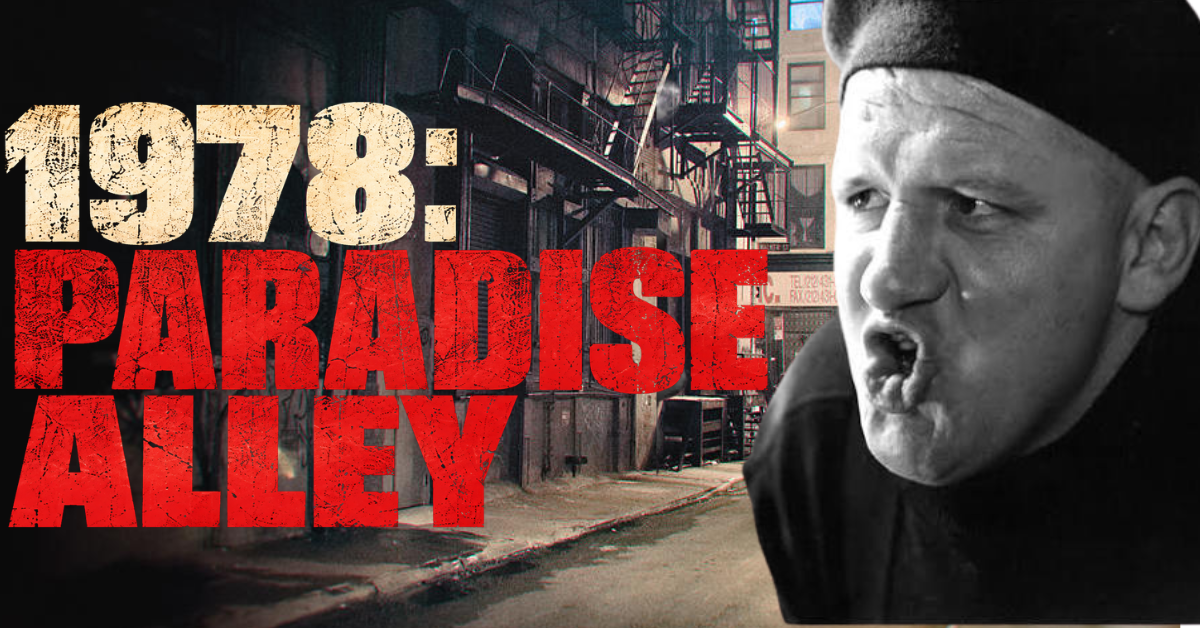
1978: Paradise Alley

- 1978: Paradise Alley - October 23, 2026
- 1977: Terry Funk Watches Terry Funk - October 21, 2026
- 1976: From West Texas to Japan: The Making of a World Champion - October 19, 2026
Part of Violent People’s FUNKIN’ FALL series: View the full index.
Terry Funk was a better actor than most of the people who made their living acting. He just happened to do most of his best work in a wrestling ring.
In 1978, he finally got the chance to take that talent to the silver screen.
When I decided to cover Funk’s 1978, Paradise Alley seemed like an obvious subject.
Paradise Alley was Sylvester Stallone’s first movie as a director, released two years after Rocky turned him into one of the biggest stars in the world. Stallone wrote it, directed it, starred in it, hell, he even sang the theme song. Sly filled his version of 1940s Hell’s Kitchen with characters with names like Stitch, Burp, Big Glory, Kid Salami, and Franky the Thumper.
Franky the Thumper was, of course, Terry Funk.
Now I have a confession to make before going any further. I had never actually seen Paradise Alley. I knew of Terry’s involvement. At some point, I must’ve read a plot description, because I had a vague idea of what it was all about.
So before sitting down to watch it, I did a little homework. Read some reviews. Looked into the production. Tried to figure out what I wanted to say about the movie and, more importantly, what it could tell me about Terry Funk in 1978.
The film has fairly mixed reviews. Most people compared it unfavorably to Rocky, which to me seems like an impossibly high standard, but it’s tough not to think of them together.
Some people are big fans. They think it’s a forgotten masterpiece.
Pauline Kael certainly didn’t think so, though.
Kael reviewed the movie for The New Yorker in November 1978 and spent most of the review taking Stallone apart. She thought his Hell’s Kitchen was made out of memories of other movies, his characters were cartoons, and his fixation on triumph kept him from exploring some of the more interesting things his own movie accidentally stumbled into.
But she noticed Terry Funk.
More specifically, she noticed Terry Funk losing.
Kael wrote that Funk “makes us understand the pain of losing.”
That’s seven words, and I’m not sure anyone ever came up with a better description of Terry Funk.
Kael’s frustration was that Stallone didn’t seem interested in what Funk had briefly made visible. Paradise Alley ultimately cared about winning. Terry, in defeat, had suggested something sadder and more complicated. The loser mattered too. Maybe the loser mattered because he lost.
This seemed like my obvious hook.
Pauline Kael understood professional wrestling better than some wrestling bookers.
There is an idea in wrestling that losing is something you have to protect people from.
A guy can lose, but make sure his foot was under the ropes. Have somebody interfere. Give him a visual pin while the referee is down. Let him get counted out. Let him get disqualified. Whatever you do, make sure everybody understands that he didn’t really get beaten.
Sometimes that’s good booking.
Do it often enough and eventually nobody ever actually loses anything.
Terry Funk understood that defeat could be useful.
Not simply because losing makes the winner look good. That’s Wrestling 101. Everybody knows somebody has to put somebody over.
Terry could get the opponent over. He could get himself over. But more importantly, Terry Funk could get the loss over.
He could make the audience understand what had happened to him. He could make the exact moment everything went wrong feel important. When Terry lost, the match didn’t necessarily become smaller because the guy you came to see had been beaten.
Sometimes it became bigger.
Pauline Kael saw it on a big screen in 1978.
There’s one big problem with the approach I had in mind. I believe everything I just wrote, but the thing is…
Paradise Alley IS a masterpiece.
I sat down to watch this film and was floored.
Not exactly how I expected this to go. I don’t have time to discuss Funk’s ability to express and use a loss like no one else. I have to tell you how amazing this film is.
Let’s start with the obvious. Terry Funk is fucking incredible in this movie.
I knew he would be good. Of course I knew that. I’ve spent enough of my life watching Terry Funk to know what he’s capable of. But there’s a difference between watching a wrestler perform in front of a few thousand people and watching an actor perform for a camera that’s practically shoved up his nose. And in this film the camera is in Funk’s face.
Terry’s face is a remarkable thing.
There are moments in Paradise Alley where he looks like someone that escaped from a mental institution. His eyes bulge, his mouth contorts, his entire face seems to completely change. He’s grotesque, intimidating, and occasionally over the top ridiculous.
He’s also impossible to look away from.
The easy explanation is that Funk was simply doing what he’d always done in the ring. And there’s certainly some truth to that. Wrestling taught Terry how to express things physically that most actors spend years trying to learn. He could communicate pain, humiliation, desperation, and anger to the cheap seats without saying a word.
The camera loves him.
Which brings me to something I hadn’t expected at all.
This movie is freakin’ gorgeous.
Seriously. Whatever you think of Stallone as a writer or actor, there are shots in Paradise Alley that have absolutely no business being as beautiful as they are.
I’m not just talking about the obvious stuff.
There’s this wonderful image of Annie’s feet silhouetted by Lenny’s cane. It’s the sort of shot that the camera lingers on making sure you appreciate it. I do appreciate it. It’s beautiful.
But it’s some of the smaller moments that have stuck with me. There’s a shot of Annie through the dirty windshield of Victor’s ice truck. Nothing especially extravagant is happening. There’s no great speech or dramatic revelation. It’s just a woman seen through a filthy piece of glass.
That’s our introduction to Annie and I can’t get that image out of my head.
Or Victor’s first meeting with Susan in the alleyway.
It’s a simple meeting between two people, but Stallone finds something in that setting, in the space between them, in the way the characters occupy this dirty little doorway of Hell’s Kitchen that tells us everything we need to know about the two people.
There’s tenderness there that I don’t think would have survived a more conventional approach.
And that’s what surprised me most about the way Paradise Alley looks.
It’s a movie about poor people living in a dirty, crowded, miserable place, but Stallone doesn’t seem to think that means their world has to be ugly.
He finds beauty in it. Cosmo may be missing the beauty, but we don’t have to.
He doesn’t do this by pretending the poverty isn’t there. The dirt, the cramped streets, the old buildings, the clutter, the grime. All of it becomes part of the picture.
There’s a real affection for this place and these people, even when it’s ridiculous or they’re doing things that make it awfully difficult to have any affection for them.
And nobody makes that more difficult than Sylvester Stallone himself.
One of my favorite things about Paradise Alley is that Stallone plays an absolute piece of shit.
I don’t mean he’s a scallywag or a lovable rogue. He’s not the kind of Hollywood bad boy who does something vaguely objectionable in the first act so he can spend the rest of the movie proving he’s actually a wonderful person.
I mean a genuine, Grade-A piece of shit.
Cosmo Carboni is a scumbag.
At one point, he pretends to be a disabled veteran, hiding his limbs so he can panhandle for money. He hits a homeless man with a trash can. He uses and abuses poor Bunchie. The man calls an old woman fat and threatens to punch her in the face. It’s great.
This is Sylvester Stallone. Two years removed from Rocky. One of the biggest movie stars in the world, making his directorial debut in a film that he wrote for himself.
He could have made himself anything.
Instead, he made himself Cosmo Carboni.
I love that.
He’s greedy, manipulative, cruel, and willing to exploit just about anybody if he thinks there’s something in it for him.
Including his own brother.
And yet, somehow, I found myself caring about him.
That’s not because Stallone excuses his behavior. It’s because the movie gives us enough of Cosmo’s past to see how somebody might become this way.
Which is where I think Paradise Alley becomes something considerably more interesting than a movie about pro wrestling.
At its heart, it’s a movie about three brothers.
Cosmo, Lenny, and Victor Carboni grew up in the same place. They came from the same family. All three know the same streets, the same people, the same poverty.
But they haven’t come out of it the same.
And I think there’s something genuinely beautiful about that.
Poverty doesn’t do the same thing to everybody.
It can make one person hard, another person desperate, and somebody else determined to hold on to whatever goodness they’ve managed to preserve.
Sometimes it does all three to the same person.
Cosmo sees the world as something to be worked. There’s always an angle, always somebody to take advantage of, always another dollar to be squeezed out of a situation.
Lenny has his own damage. His own disappointments. His own ways of dealing with a life that hasn’t turned out the way he might have imagined. He’s reserved, introverted and seems to be just going through the motions of life.
And then there’s Victor.
Poor Victor.
Victor is physically enormous. He makes Stallone look tiny. He’s also the one least interested in taking advantage of anybody. The obvious comparison is Lennie from Of Mice and Men.
It’s heartbreaking watching a man with that much physical strength get pulled around by the ambitions of people who love him. Because I do think his brothers love him.
That’s the thing. Cosmo can be a horrible bastard and still love Victor. He can want something better for himself while simultaneously treating the people in that family terribly. He can convince himself that exploiting his brother is actually helping him.
Those things aren’t mutually exclusive.
People are complicated. Families are complicated. Love doesn’t automatically make somebody a good person. And poverty has a way of making all those complications worse.
I think that may be what I liked most about Paradise Alley. Beneath the stupid names, the broad over-the-top performances, and the wrestling, there’s a story about three men trying to escape the same circumstances without ever entirely understanding what those circumstances have done to each of them.
They’re brothers. They love one another. They hurt one another. It’s a story about brotherhood, but not some romanticized version of brotherhood where everybody puts their arms around each other and learns a valuable lesson.
It’s about what happens when the people you love are also the people most capable of hurting you.
Let’s get back to Pauline Kael.
I can understand why someone would watch Paradise Alley and see Stallone borrowing from other movies, a cast of grotesques, and a story that occasionally seems more interested in being colorful than being believable.
But I wonder if some of the things she disliked are exactly what I love about it.
The exaggerated characters. Its overly sentimental ending. The willingness to let people be ridiculous one minute and heartbreaking the next.
Those are things I’ve spent most of my life appreciating in professional wrestling. That probably makes me particularly susceptible to a movie like this.
I don’t need every character to behave like a real person behaves every moment of every day. I don’t need every emotion expressed with perfect restraint. Sometimes I want somebody to be larger than life. There are times I want a face that tells me everything I’m supposed to feel before a single word comes out of somebody’s mouth.
Sometimes I want Terry Funk.
Which brings us back to Franky the Thumper.
Franky isn’t the protagonist of Paradise Alley. He’s an obstacle in somebody else’s story. Funk doesn’t let him be just that.
He gives Franky something beyond his function in the plot. He gives him pride, anger, and an understated sense of humor.
Franky doesn’t know he’s a supporting character in a Sylvester Stallone movie. As far as Franky is concerned, this is his story too. That’s what Terry Funk was so good at.
Think about how many wrestling matches are structured around the same basic idea. One man has to beat another man, and the audience has to care about the result.
Simple enough.
But the difference between a good match and a great one often comes down to whether both men convince you that the result actually means something to them.
That’s what Funk did best.
In Paradise Alley, he brings that gift to a movie camera.
But now that I’ve actually seen the film, I’m not sure I agree that Stallone failed to understand the power of losing.
I think the movie is full of people who are losing things.
Not always wrestling matches. Sometimes it’s their dignity. Sometimes it’s their love. Sometimes it’s their chance to become something different from what the world seems to have decided they’re going to be.
The Carboni brothers have been losing for most of their lives.
They’ve been losing to poverty, to war, to circumstance, to their own weaknesses, and occasionally to each other.
Victor’s wrestling offers the possibility of a win, but the movie isn’t really about whether he can beat Franky the Thumper.
It’s about what that victory might cost him. And what it might cost all the brothers.
That’s what I think Kael missed.
She saw Terry Funk make defeat meaningful, but I think Stallone was trying to do something similar with the entire movie.
There’s a sincerity to Paradise Alley that can be almost overwhelming at times. Stallone really believes in these characters. He loves this world he’s created, even when the people living in it are awful. He allows the movie to be ugly and beautiful, ridiculous and moving, sometimes within the same scene.
I started working on this essay thinking I was going to use a bad movie to explain something wonderful about a great professional wrestler.
Pauline Kael had already done most of the heavy lifting for me. All I had to do was connect her observation to the wrestling career, bring up some matches as examples, and explain why defeat was such an important part of what made Terry Funk special.
I still believe all of that.
But instead I fell in love with the movie.
And perhaps that shouldn’t have surprised me.
After all, I’ve always believed that professional wrestling can accomplish things that other forms of entertainment can’t. That it can make us care about ridiculous people doing ridiculous things. That a man can be a monster one minute and break your heart the next. That the audience doesn’t always need subtlety to experience something profound.
Paradise Alley understands all of those things.
More FUNKIN’ FALL: See every year in the series