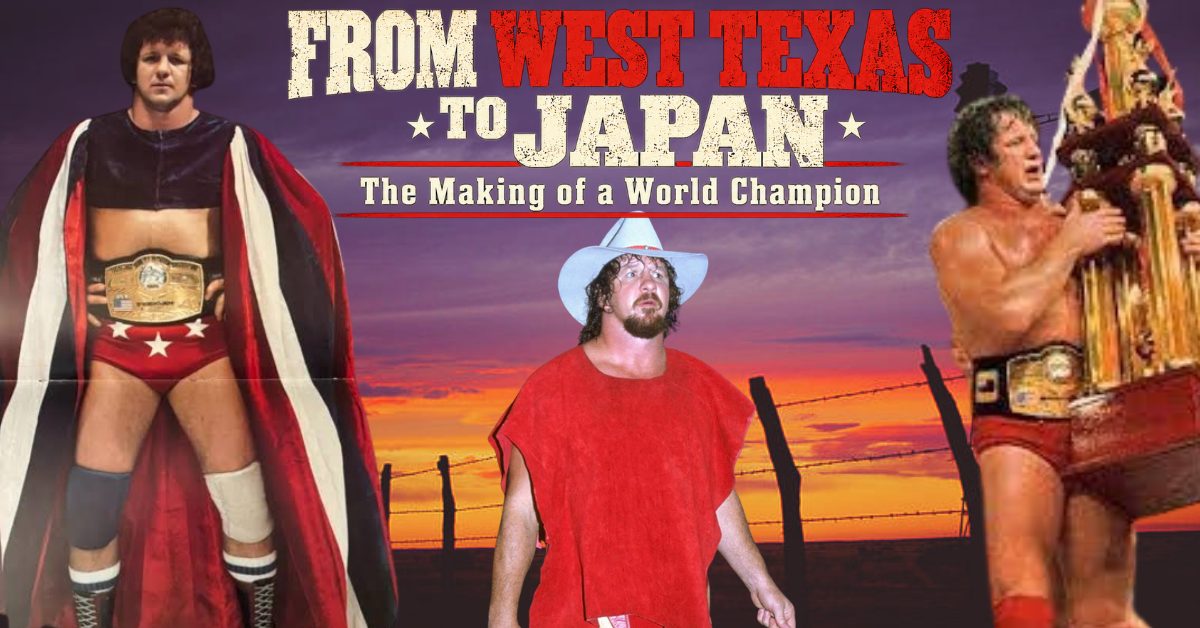
1976: From West Texas to Japan: The Making of a World Champion
Written by Tony Richards
Part of Violent People’s FUNKIN’ FALL series: View the full index.
1976 was a remarkable year in American professional wrestling, a year in which the United States celebrated its bicentennial, the National Wrestling Alliance continued to serve as the sport’s most influential pro wrestling organization, and Terry Funk carried professional wrestling’s most prestigious prize across the country and around the world.
For Funk, the year was about far more than wearing the NWA World Heavyweight Championship. It was a test of endurance with the brutal schedule, a demonstration of his ability to work with virtually every style of opponent, and an opportunity to establish himself as a world champion in his own right. He had inherited the championship from Jack Brisco in December 1975, and the wrestling business now had to discover what kind of champion Terry Funk would become.
Would he be a traveling champion who could draw in every major NWA territory? Could he defeat the established stars who had spent years building their own reputations? Could he represent the alliance internationally while maintaining his connection to the Funk family’s West Texas wrestling tradition? Could he be the leader the NWA member booking offices needed, coming in to work with the leading draw and leaving the market better than before? And could a man whose own personal wrestling brand was increasingly defined by aggression, toughness, and unpredictability carry the responsibilities of the championship for an extended period?
By the end of 1976, Funk had answered those questions convincingly. He remained NWA World Heavyweight Champion throughout the calendar year, defended the title against an extraordinary variety of challengers, traveled internationally, and continued to be one of the defining attractions of the territorial era. His bicentennial was not simply a successful championship year. It was a defining chapter in the career of one of wrestling’s most distinctive performers.
The Champion Entering America’s Bicentennial
To understand the importance of 1976, we turn back the clock even further to December 10, 1975, when Funk defeated Jack Brisco in Miami to win the NWA World Heavyweight Championship.
Brisco had been an outstanding champion, one of the best actually, a technically accomplished wrestler whose amateur background and scientific approach represented the traditional ideals of the NWA. Funk was a different proposition. Although he possessed excellent technical ability, he was more unpredictable, more physical, and more willing to make a championship match look like a desperate struggle for survival.
The title change represented a significant transition in the championship’s presentation. Funk was not a temporary novelty or a regional favorite being given an opportunity to test himself against the world’s best. He was the son of Dory Funk Sr., the brother of Dory Funk Jr., and a product of the West Texas wrestling culture that had made toughness a central part of its identity. He had spent years learning the business, from the inside, traveling through territories, and proving himself against established opponents.
Terry had also demonstrated that he could succeed outside his family’s promotion. His recent championship accomplishments in important territories, had already set him up with angles and challengers for his title run and included the NWA United States Heavyweight Championship in the Mid-Atlantic territory and the NWA International Heavyweight Championship in West Texas. He had ready-made opponents coming back as the world champion in Paul Jones in the Carolinas, The Super Destroyer (Art Nelson) in West Texas, Pat O’Connor and Harley Race in St. Louis and Kansas City. He had developed into a substantial singles attraction before becoming world champion.
In the fall of 1975, Jim Crockett Promotions found itself rebuilding after the October plane crash that ended Johnny Valentine’s career and left the NWA United States Heavyweight Championship vacant. Booker George Scott answered with a one-night tournament at the Greensboro Coliseum on November 9 that drew a record house. Terry Funk, the hard-nosed Texan, fought through four matches that night—including bouts against Red Bastien, Rufus R. Jones, and Dusty Rhodes—before meeting Paul Jones in the final. Both men were exhausted, yet they delivered a long, hard-fought championship match. Funk ultimately cradled Jones for the win, but not before Jones had opened Funk up with a punch that required eighteen stitches later that night. Funk, true to form, boasted he would take the U.S. title back to Texas. NWA President Jack Adkisson (Fritz von Erich), who had been at ringside and seen a disputed near-fall, forced a rematch on the annual Thanksgiving night card back in Greensboro.
On November 27, Jones evened the score and regained the United States title in another fiercely contested main event. The two Greensboro shows that month became legendary in Mid-Atlantic lore, with both men later recalling the physical toll and the electricity of the buildings. Weeks later, Funk stunned the wrestling world by defeating Jack Brisco for the NWA World Heavyweight Championship in Miami. Suddenly, the man Jones had just beaten for the U.S. belt was the world champion, making “Number One” Paul Jones the logical and most credible challenger in the Crockett territory.
Throughout 1976, Funk returned to the Mid-Atlantic area for a series of high-stakes world-title defenses against Jones. The program played out across Greensboro, Raleigh, Roanoke, Charleston, Greenville, and Richmond, with matches often ending in time-limit draws or disqualifications that kept the tension alive without changing the title. Jones, still the top local babyface and a multiple-time U.S. champion who traded the belt with Blackjack Mulligan, carried the credible claim that he had Funk’s number. Funk, for his part, cut classic promos—most memorably on the February 14, 1976, edition of Wide World Wrestling—calling out Jones over the earlier loss and positioning the Mid-Atlantic star as his primary regional threat. The series reinforced both men’s standing: Funk as a fighting world champion who could deliver big matches anywhere, and Jones as the undisputed top contender and drawing card of the Crockett territory. It was, as Funk himself later noted, a brilliantly booked situation by George Scott that kept the world title strong, kept Jones strong, and drew strong houses across the Carolinas and Virginia.
The NWA World Heavyweight Champion was not simply the top wrestler in one city or the principal attraction of one promotion. The champion represented a network of regional NWA member booking offices, each with its own television exposure, local stars, promotional priorities, and financial interests. A world champion needed to make the championship meaningful in each office’s territory without diminishing the importance of its established attractions. Funk’s responsibility was to travel, defend, sell the next match, and leave each territory with the championship’s prestige intact and the challenger looking strong, having nearly beaten the champion. He had entered 1976 with the belt, the backing of the NWA, and an opportunity to establish a reign that would be remembered long after the bicentennial celebrations ended.
A Different Kind of World Champion
Funk’s greatest advantage was that he did not need to wrestle every opponent the same way.
Against a skilled technical wrestler, he could engage in a prolonged contest of holds, counters, and escapes. Against a power wrestler, he could make the match a physical battle. Against a notorious rule-breaker, he could become just as rough and calculating as his opponent. And against a local hero, he could make the audience believe that its favorite had a genuine chance of winning the championship.
This adaptability was essential to the NWA system.
A champion visiting a territory had to accommodate different audiences and different promotional traditions. Some towns expected scientific wrestling. Others wanted a fight. Some audiences preferred a champion who won decisively, while others responded more strongly to a champion who survived a dangerous challenger by the narrowest possible margin.
Funk could supply all of these experiences without losing his identity. His appearance and manner also distinguished him from Brisco. Funk could look like a champion and still project the image of a man who might lose control of a match at any moment. His intensity was not merely an act of aggression; it became part of the drama surrounding the championship. When an opponent threatened to defeat him, the audience could believe that Funk would have to dig deeply into his reserves to survive.
That quality helped make his title matches compelling. The question was not always whether the challenger possessed enough wrestling ability to beat the champion. It was whether the challenger could withstand Funk’s determination, toughness, and willingness to take the match into uncomfortable territory. Funk was a world champion who could win a wrestling match, but he could also make a championship defense feel like a fight.
The Territorial Champion at Work
The NWA’s territorial structure was both the championship’s greatest strength and one of its greatest challenges.
In 1976, there was no single national television program capable of presenting every major wrestling star to the entire American audience each week. Instead, fans followed local promotions, regional television programs, newspapers, radio announcements, and arena events. WTCG TV-17 from Atlanta would have a handful of regional cable connections by the Summer of ’76, but the major stroke, the satellite uplink would not be accomplished until late in the year. This one singular event would completely change the pro wrestling business paradigm, enabling fans, for the very first time, to see pro wrestling product from outside their own region and outside the limitations of their outdoor VHF or UHF antenna. This would erase the boundaries of the booking office territories and allow fans to compare product and talent.
Prior to this event, the NWA World Championship and the pro wrestling magazines were the only connective tissue for the individual markets. Funk’s travels therefore had an importance beyond the matches themselves. When he appeared in a city, he brought the authority of the NWA championship into a local wrestling environment. The hometown promotion could advertise a world title match, feature its own leading wrestler against the champion, and present the event as an opportunity to see the best of the local territory tested against the best the business had to offer.
The challenger did not necessarily need to win for the match to succeed. A draw, a disqualification, a count-out, or a narrowly lost contest could establish the local star as a credible threat and create demand for another meeting. Funk’s title reign benefited from this system because his opponents were not interchangeable. They had different reputations, wrestling styles, regional followings, and relationships with the audiences watching them.
In one territory, he might encounter a technically accomplished veteran. In another, a powerful heel who specialized in rough tactics. Elsewhere, he might face a popular babyface whose supporters believed that the champion had finally met his match. Every territory could tell its own story around the same championship. That was the essential function of the NWA World Heavyweight Championship during the territorial era, and Funk’s busy schedule made him one of its most visible representatives.
January and February: Establishing the Reign
Funk’s opening months as champion were important because he had to prove that his December victory was the beginning of a legitimate championship reign rather than an isolated upset.
The first of the year had him defending against a broad cross-section of opponents in January, including Abdullah the Butcher, Dick Slater, Pat O’Connor, Edouard Carpentier, Thunderbolt Patterson, Billy Robinson, Dusty Rhodes, Stan Stasiak, Jose Lothario, Peter Maivia, Dick Murdoch, Danny Hodge, Greg Valentine, and Bill Watts.
The range of names is revealing. These were not all wrestlers with similar styles or reputations. Funk was being tested by established stars, regional headliners, former champions, and wrestlers whose abilities made them credible championship challengers in their own right.
The early January schedule included a draw with Billy Robinson in Tampa, a double count-out with Dusty Rhodes in Miami, and a victory over Rhodes in Jacksonville. These results illustrate the flexibility of the NWA championship program. Funk could win one encounter and leave another unresolved, allowing the promotion to preserve the challenger as a threat.
The January 15 meeting with Pat O’Connor in Amarillo was particularly appropriate. O’Connor was a former NWA World Heavyweight Champion whose technical credentials and reputation carried considerable weight. O’Connor had defended his title in some epic matches with Dory Funk, Sr through the West Texas territory. A championship defense against him linked Funk’s reign to the title’s established tradition. The champion also continued to work in Texas, where his family name and connections to Western States Wrestling made him a familiar attraction. Appearances in Amarillo, Lubbock, Odessa, San Antonio, Corpus Christi, Houston, and other markets kept him connected to the region that had helped develop his career.
Having his older brother be the majority shareholder of the Amarillo member office and the long-standing relationship with Fritz Von Erich, the Dallas Member office owner and the current NWA President made Texas an important and significant area for the champion. These were the only two talent offices for the entire State of Texas at the time.
February brought further tests, including a February 6 meeting with Harley Race in St. Louis, the mecca for NWA wrestling worldwide. A former world champion and close Funk Family tie, Race would become one of Funk’s most important rivals during the reign, and their matches represented the collision of two wrestlers whose toughness and technical ability made them natural opponents for the NWA championship.
Funk also faced Dusty Rhodes, Jack Brisco, and other prominent challengers during the month. The significance of these opening weeks was cumulative. Funk was not defending against one carefully selected rival while avoiding everyone else. He was carrying the championship through a demanding circuit, meeting different opponents, and giving each territory a reason to regard him as a genuine world champion.
By the end of February, the reign had acquired momentum. Funk was establishing a reputation as a champion who would show up, take on the local attraction, and put the title at stake.
March and April: Harley Race, Dusty Rhodes, and the Championship’s Demands
March and April demonstrated why Funk’s reign was so well suited to the NWA’s territorial system. The champion had to remain convincing against opponents who could challenge him on very different terms, and he had to do so while traveling constantly. Some of those opponents were well-established stars while some were emerging performers.
One of the focal points of March was a series of matches against one of the young, emerging performers, Chavo Guerrero, the popular local NWA Americas Heavyweight Champion and son of the legendary Gory Guerrero. Funk’s presence brought national prestige to the territory, while the program with Guerrero blended hard-hitting action, family pride, and the multicultural heat that defined Olympic Auditorium cards.
The series built quickly. On March 2 in San Diego, Funk and Guerrero went to a 60-minute time-limit draw before roughly 3,000 fans, showcasing Guerrero’s endurance against the champion. Two nights later in Bakersfield, Chavo and Gory Guerrero teamed against Funk and a young Roddy Piper, winning a long tag match. The climax came on March 5 at the Olympic Auditorium. In a main-event world-title match, Funk drove Guerrero with a piledriver on the concrete floor outside the ring. The bout reached the one-hour mark without a pinfall. When offered five extra minutes, Guerrero accepted; Funk refused. The result was a disqualification victory for Guerrero. The Olympic crowd erupted as if their hometown hero had dethroned the NWA World Champion—an electric, almost magical reaction that cemented Guerrero’s status as the territory’s top babyface even though the world title remained with Funk. Promotional heat had already been stoked by taped promos from Funk that crossed ethnic lines and by handbills offering a bounty to injure Guerrero, raising ticket prices and packing the building.
The program did more than elevate Guerrero. It also planted the seeds for one of the territory’s most memorable heel runs. Piper, still early in his Los Angeles tenure, was already positioned as the abrasive foreigner. On the same March 5 card, he defeated Gory Guerrero, and just one week later—on March 12 at the Olympic—he took the NWA Americas title from Chavo. That victory launched their long, intensely personal feud, built on cultural clash, Piper’s provocative promos, and bloody matches that drew strong houses for years. A later July 2 Olympic rematch between Funk and Guerrero, with Piper suspended in a shark cage, further tied the champion’s visits to the rising local rivalry. Funk’s 1976 Los Angeles appearances gave Guerrero the credibility and crowd momentum to stand as the territory’s signature star while simultaneously introducing Piper as the cunning, heat-drawing heel who would define the next chapter of NWA Hollywood and he would become one of the wrestling business’ most impactful heels.
In the established veteran category, Harley Race was among the most significant of those opponents. Race represented a formidable combination of strength, technical ability, stamina, and ring intelligence. He was not merely a challenger who could be presented as dangerous for one evening. He was a wrestler whose entire career made him a credible future world champion.
Funk and Race met repeatedly during 1976, and their rivalry became one of the defining competitive threads of the year. Their February encounter in St. Louis had already established the attraction. Subsequent matches reinforced the idea that Funk could not simply overpower Race or dismiss him as another challenger.
The importance of the rivalry extended beyond individual results. A long-running championship program between two established performers gave the NWA a dependable attraction that could be revisited across different markets. Each meeting added to the history between them, and each unresolved result provided a reason for another match.
Funk’s relationship with Dusty Rhodes was equally valuable, although it worked differently.
Rhodes was developing into one of the most charismatic and popular wrestlers in the country. His ability to connect with audiences made him a natural challenger for the world championship. Against Funk, he represented a different kind of threat: the ambitious, determined wrestler whose popularity could make an arena believe that the championship might change hands. Rhodes was also a Texan, which seemed to give the fans a deeper connection to the feud.
Funk also remained active in his home region. On April 14 and 15, he met Harley Race in Abilene and Amarillo, respectively, winning both recorded encounters. Those matches brought the world championship into the West Texas circuit and demonstrated that the champion’s connection to his home territory did not end when he won the NWA title.
The West Texas audience was seeing one of its own carry the highest championship in the business. For the Funk family, this was a continuation of a tradition that Dory Funk Sr. had helped establish, winning the NWA World Junior Heavyweight Title in the late 1950s and that Dory Funk Jr. had extended through his own success.
May and June: The World Champion Goes International
One of the most important aspects of Funk’s 1976 reign was its international dimension.
The NWA championship had a presence beyond North America, and Japan was becoming an increasingly important part of the world wrestling landscape. All Japan Pro Wrestling, founded by Giant Baba in 1972, had established relationships with American promoters and continued to bring major international wrestlers to Japanese audiences.
Funk’s June tour of Japan placed the NWA World Heavyweight Championship before an audience that was becoming familiar with both American and Japanese wrestling styles.
On June 11, Funk defended the championship against Jumbo Tsuruta in Tokyo. The match was contested under best-two-out-of-three-falls rules, and Funk retained the title. Tsuruta was one of the most important young wrestlers in Japan, possessing the amateur background, size, and athletic potential to become a leading star. Matching him with the NWA champion offered a significant test of his development. Funk and Tsuruta were very familiar with one another. The relationship between the Amarillo talent office and Giant Baba’s All Japan Pro Wrestling was strong. Baba had made an agreement with the Amarillo office to book American talent into his Japanese promotion and also included his sending talent to Amarillo for development. Tsuruta had been one of those talents.
For the champion, the match required him to represent the championship in a wrestling environment with its own expectations. Japanese audiences placed considerable emphasis on competitive intensity, endurance, and the credibility of the contest. The best-two-out-of-three-falls format suited the occasion, allowing the match to unfold as a sustained struggle rather than a brief championship encounter.
The defense also demonstrated the international value of the NWA title. Funk was not simply a traveling American star appearing in Japan. He was the recognized world champion, and his matches could be used to establish the standing of Japanese wrestlers against a championship holder from the United States.
The relationship between the Funk family and Japanese wrestling would prove enduring. Dory Funk Jr. had already developed a strong international reputation, and Terry’s championship tour reinforced the family’s association with high-level competition in Japan.
June also saw Funk continue his North American schedule. One of the notable Texas attractions was his championship match against Rocky Johnson in Houston. Johnson was a powerful, athletic wrestler whose combination of speed and strength made him a credible challenger. The major hype of the year had been the mixed boxer vs wrestler match between Antonio Inoki and Muhammad Ali. Wrestling promoters took advantage of this awareness and used Johnson’s former boxing activities to promote matches between him and Funk. Johnson’s matches with Funk helped bring the world title to audiences who might otherwise have followed the champion primarily through regional reports and television. The Japanese tour and the domestic defenses illustrated two complementary responsibilities. Funk had to sustain the championship’s international prestige while continuing to serve the American territories that depended on his appearances.
He was doing both.
July: The Champion and His Home Territory
July brought Funk back through a demanding schedule that included multiple regional markets and another important chapter in his West Texas story.
On July 1, Funk defeated the Super Destroyer in Amarillo to regain the Western States promotion’s NWA International Heavyweight Championship. That title was a significant regional championship, but holding it alongside the world title would have created competing obligations. Funk vacated the International championship later in July so that he could concentrate on his NWA World Heavyweight Championship responsibilities. It really was a way to blow off the program with Nelson, so both wrestlers could move on. Funk could get his decisive win, and Destroyer could start a new program with Larry Lane and others in the local territory.
The July schedule also brought Terry Funk into contact with several of the business’s most prominent performers. His travels included appearances on the West Coast, Mid-Atlantic, Florida, Gulf Coast, and other regional markets, while his matches continued to supply local promoters with a major championship attraction.
One of the year’s important programs was the continuing rivalry with Dusty Rhodes. In Georgia, Funk’s championship match against Rhodes on July 16 ended in a disqualification victory for Funk. The result preserved the championship while protecting Rhodes as a legitimate contender. That finish was a familiar territorial booking device, but it was particularly effective with two wrestlers of this caliber. Rhodes could claim that he had been denied a fair opportunity to win the championship, while Funk could maintain that he had defeated the challenger according to the referee’s decision. Neither wrestler needed to be decisively weakened, and another encounter could be promoted.
Funk’s July appearances demonstrated the balancing act required of a traveling champion. He had to provide a meaningful contest for local audiences, protect the championship, and leave room for future programs. He also had to maintain a schedule that could be physically exhausting. For a wrestler with Funk’s intensity, this was no small task. His matches frequently demanded a high degree of physical commitment, and his approach was not built around making every appearance look effortless. He worked as though the championship was something that had to be defended through determination and force.
August: The NWA Champion in a Changing Business
August 1976 is especially interesting when viewed against the broader development of the NWA.
The alliance remained an influential organization, but its member promotions were increasingly operating as powerful regional businesses with distinct identities. This was the period that Pro Wrestling Time Tunnel identifies as the second year and eighth month of Stage 6, Fragmentation, in its seven-stage model of the Territory Era.
The world champion’s role was central to that system. A territory could promote Funk against its leading star, use the championship to create a major event, and then return to its regular programming after the champion departed. The title supplied a common attraction across otherwise separate regional wrestling economies.
Funk’s August itinerary demonstrated this process in action.
The month included work in Central States, the Tri-State area, St. Louis, Florida, Georgia, Memphis, and Texas. His opponents included Bob Brown, Harley Race, Dick Murdoch, Steve Keirn, Bob Roop, Dusty Rhodes, Rocky Johnson, and Jose Lothario, among others. His August 5 championship match with Harley Race in Kansas City ended in a disqualification, preserving Funk’s title while keeping Race in the picture. The fact that their rivalry could be presented in a market outside either man’s most familiar territory underscored the reach of the championship program.
The Florida portion of the schedule placed Funk against wrestlers who were important to Eddie Graham’s promotion. The Georgia appearance against Dusty Rhodes continued the developing rivalry between Funk and one of the country’s most popular babyfaces. Texas dates brought the champion back into familiar territory, where his name and family background remained important parts of the local wrestling identity.
August also brought the NWA membership together at Lake Tahoe for its annual convention. Eddie Graham was elected NWA president, succeeding the outgoing administration in a period when the alliance was navigating changes in its leadership and regional relationships. It is important not to confuse the political developments of the convention with the championship booking. At the time, there was no dissatisfaction over Funk’s reign. He continued as champion, and the prevailing attitudes about his time as champion indicate that the NWA membership believed the championship remained a successful attraction.
Funk later recalled in his book, “More Than Hardcore” that he had hoped to keep the world title for two years. As far as we can surmise, his reign was not being ended, and there was no immediate change in the championship’s direction. The NWA was a business built on cooperation among promoters who also competed for wrestlers, audiences, and revenue. The world champion was one of the most important, shared assets in that arrangement. Funk’s ability to travel and draw across territories helped demonstrate the continuing value of the alliance’s championship structure. His bicentennial was unfolding at a time when the regional system remained powerful, even as the forces that would eventually transform it were beginning to take shape.
September: The Funk–Rhodes Rivalry and the Texas Connection
September continued the pattern that had defined Funk’s championship year: a combination of major regional programs, familiar West Texas opponents, and demanding travel between territories.
The month featured an important Atlanta appearance against Georgia Heavyweight Champion Dick Slater. On September 10, Funk wrestled Slater for sixty minutes at Atlanta’s Municipal Auditorium. The time-limit draw was an effective way to present two established champions without diminishing either man’s standing. Slater could demonstrate that he belonged in the ring with the world champion, while Funk retained the NWA title. The middle of the month brought Funk back to Western States Wrestling. His itinerary included Dennis Stamp in Odessa, Swede Hanson in San Angelo, Fritz Von Erich in Amarillo, and a Texas Death Match against the Super Destroyer in Lubbock.
The Fritz Von Erich match was particularly significant from a Texas wrestling perspective. Fritz had spent years developing his identity as a major attraction in the state, and his transformation into a beloved Texas hero was becoming increasingly important to the business. A match with the reigning NWA World Heavyweight Champion gave Fritz a platform on which to demonstrate his stature beyond his own territory.
The encounter ended in a disqualification, preserving Funk’s championship while allowing the local audience to see its hero stand against the world champion. Funk’s return to Texas also reinforced the family’s continuing influence in the regional business. Dory Funk Sr. had helped establish the Funk name in wrestling, and Dory Funk Jr. had already won the NWA World Heavyweight Championship in 1969. Terry’s success represented another stage in that family’s history, but it was also a distinct accomplishment. He had developed a personality and wrestling style that could stand independently of his father’s and brother’s achievements.
Late September took Funk to Florida, where the rivalry with Dusty Rhodes continued. Their September 27 meeting in West Palm Beach ended in a double count-out. Funk subsequently defeated Ray Candy in Tampa and the Assassin in Miami Beach.
The Rhodes match was another example of how the NWA could sustain a championship program without forcing a definitive conclusion every time the champion and challenger met. Their rivalry had enough credibility to survive a series of inconclusive finishes, and the audience could reasonably anticipate another encounter. September therefore represented the champion at work in several different capacities: international attraction, Texas wrestling institution, opponent for regional champions, and antagonist to one of the most popular babyfaces of the period.
October: The Championship’s Endurance
October was another important month in Funk’s bicentennial because it demonstrated the durability of his position. He had been NWA World Heavyweight Champion for approximately ten months, yet his title reign continued to be built around the same essential principles: regular defenses, credible opponents, and an itinerary that took him into multiple wrestling markets.
One of the defining features of the autumn was the continuing Harley Race rivalry.
On October 7, Funk and Race met in Kansas City in a best-two-out-of-three-falls championship match. The contest ended in a sixty-minute draw, with each man taking a fall. It was a particularly appropriate format for two wrestlers whose reputations rested on stamina, technical ability, and toughness. The result allowed Race to demonstrate that he could go the distance with the champion without winning the championship. Funk, meanwhile, had to withstand a full hour of competition against one of the NWA’s most formidable contenders.
The match also showed why a long championship reign could be sustained through recurring encounters. A time-limit draw did not end the rivalry; it gave both men an argument for another meeting. Race could claim that he had matched the champion, while Funk could point out that he had retained the title. Funk’s October schedule also took him through other regional promotions. His continued appearances helped the NWA maintain the championship’s presence across the country as the wrestling business approached the end of another year.
October is an important reminder that a successful world championship reign cannot be judged solely by the number of title changes or the fame of a single opponent. It must also be judged by how effectively the champion keeps the title meaningful across many different markets.
Funk had now spent most of a year carrying that responsibility. His championship was not merely an item of personal prestige; it was a working attraction for the NWA’s network of promoters.
November: The Champion’s Place in Wrestling History
November continued Funk’s championship program, including another significant meeting with Harley Race.
On November 26, Funk defeated Race in St. Louis in a best-two-out-of-three-falls match, winning two falls to one. The result was a contrast with their October draw. Race had demonstrated that he could go sixty minutes with the champion, but Funk now emerged victorious in a contest that required him to win two falls. The match was a useful reminder of the difference between surviving a championship challenge and winning one. Race remained a credible contender, but Funk had successfully defended the title against him.
By this point, Funk’s reign had become an important part of the NWA’s championship history. He had faced established stars, regional champions, rising performers, and wrestlers with different styles and reputations. His success was not based on avoiding difficult opponents. It was based on being able to work with them.
The November schedule also illustrated the NWA’s capacity to revisit established programs. A world championship was most valuable when audiences believed that the champion could be challenged, that a challenger might eventually win, and that a rematch could produce a different result. Funk and Race embodied that uncertainty. Their matches were competitive enough to sustain interest, and their contrasting personalities made the rivalry more than a simple succession of title defenses.
The champion was now approaching the first anniversary of his victory over Jack Brisco. His reign had already established that he could handle the responsibilities of the office, but the story was not finished.
December: One Year as World Champion
December 1976 marked the first anniversary of Funk’s victory over Jack Brisco.
When Funk captured the championship in December 1975, he had become the latest member of a distinguished group of wrestlers entrusted with the NWA’s most important title. By December 1976, he had spent an entire calendar year defending that championship and carrying it through the territorial system.
The anniversary was an opportunity to assess what he had accomplished.
Funk had defended against Harley Race repeatedly. He had worked programs with Dusty Rhodes, met Rocky Johnson in Texas, wrestled Jumbo Tsuruta in Japan, and faced a wide variety of established wrestlers across the United States. He had returned to West Texas, appeared in major metropolitan markets, and represented the championship in territories with very different wrestling traditions.
He had also retained the title through a series of finishes that served the needs of the NWA’s regional promotions. Draws, disqualifications, and count-outs allowed the alliance to preserve the championship while giving challengers reasons to demand another opportunity.
By the end of the year, Funk’s reign had become much more than a novelty or a transitional championship period. He had established himself as a durable champion whose schedule and match quality justified the trust placed in him.
Yet his reign was not destined to continue indefinitely.
Funk’s championship run would end on February 6, 1977, when Harley Race defeated him in Toronto. The title change brought an end to a reign that had lasted nearly fourteen months from December 1975 to February 1977.
The significance of that ending should not obscure what Funk accomplished in 1976. He had carried the championship through the entire bicentennial year, and the demands of that work were central to the reign’s success.
Terry Funk’s Personal Life in 1976
The story of Terry Funk in 1976 is primarily a wrestling story, but his personal life provides important context for understanding the man behind the championship.
Funk was born on June 30, 1944, in Hammond, Indiana, and grew up in a wrestling family that became closely associated with Amarillo, Texas. His father, Dory Funk Sr., was a respected wrestler and promoter, while his older brother, Dory Funk Jr., had become one of the most accomplished wrestlers of his generation.
Terry’s upbringing exposed him to the business from an early age. He learned that professional wrestling required more than physical ability. It demanded an understanding of audiences, promotional storytelling, travel, and the relationships between wrestlers and the people who operated the territories.
He attended West Texas State University after graduating from Canyon High School, competing in football and developing his athletic background before pursuing professional wrestling full-time. He made his professional debut in December of 1965 and was developed through the Western States territory.
In August 1965, Terry married Vicky Ann. By 1973, they had built a family life alongside his demanding wrestling career, and they would raise two daughters, Stacy and Brandee. His father’s death, which he was present for, hit Terry like a sledgehammer. He kept a grueling schedule, trying to maintain the Amarillo office, the territory and he spent a lot of time working in the Florida territory. Many times he suffered massive anxiety attacks, which coupled with his emotional grief of his father’s passing, caused him to think he was suffering the same heart attacks that had claimed his Dad. All of the work pressures, the personal trauma and continual traveling mounted stress on he and Vicky’s relationship to the point their marriage collapsed and ended in divorce. Finally, at the end of 1974, Terry could no longer deal with the business issues, and he sold his ownership points in the Amarillo office. He eventually melted down in a locker room in Colorado telling Dory Jr his frustrations with his health, his finances and his life.
This emotional breakdown prompted Junior to make it his personal goal to try to get the World title to Terry. Junior believed the money Terry would make could get him up on his feet and that his younger brother could rise to the occasion and the level the NWA World Championship required of a wrestler at the time. Using political skills learned from his father, Junior managed to sway enough of the Championship committee to result in a tie between Terry and Harley Race to succeed Jack Brisco as champion. The new NWA President, Fritz Von Erich, had the tie-breaking vote, which he cast for Terry.
This would substantially change everything about Terry Funk’s life at the time.
The world championship would require him to spend substantial amounts of time traveling between cities, often wrestling several times during a single week. The champion’s responsibilities extended beyond the main event itself: travel, preparation, promotional appearances, and the physical recovery necessary to continue performing. Funk’s public wrestling persona was intense and sometimes volatile, but his professional career was supported by the personal relationships and family commitments that existed outside the ring, which at the time, were not many.
During his title run, the communication between he and Vicky began to open up again. When Terry was in West Texas on his title schedule, they would occasionally see each other. Terry stated that during his title reign in 1976, he made around $400,000 that year, which solved a lot of his financial woes and allowed him to invest in a ranch in Canyon, Texas.
The year 1976 represented the beginnings of both the professional and personal change of direction for Terry Funk.
It is also important not to project the later stages of Funk’s career backward onto this period. The extreme and often violent wrestling persona that became particularly prominent during his later years had not yet reached its best-known form. In 1976, Funk was already capable of intense, physical performances, but he was operating within the established framework of the NWA’s territorial championship system.
His later reputation for hardcore wrestling grew out of a much longer career. The bicentennial year was a crucial part of the foundation, not the conclusion but a major transition, of his story.
The Significance of the 1976 NWA Championship Reign
The value of Funk’s bicentennial can be measured in several ways.
First, he established the credibility of his reign. His victory over Jack Brisco had been a major moment, but the months that followed demonstrated that he could sustain the championship against a wide range of challengers.
Second, he proved his versatility. Funk’s opponents included technically accomplished wrestlers, powerful competitors, regional champions, and rising stars. His ability to work with such a variety of performers helped preserve the title’s relevance across different territories.
Third, he contributed to the international standing of the NWA. His Japanese tour, including the championship defense against Jumbo Tsuruta, demonstrated that the title could serve as a bridge between American and Japanese wrestling.
Fourth, he helped sustain the territorial model itself. The champion’s schedule gave regional promoters access to a major attraction without requiring them to surrender their own local identities. The championship could elevate a local star even when the challenger did not win.
Finally, Funk’s reign added another chapter to the NWA’s championship history. He followed Jack Brisco and preceded Harley Race, two wrestlers whose own reputations became closely associated with the title. His position between them is significant because his reign helped connect different eras of NWA championship wrestling.
Funk was not necessarily the most conventional champion, nor was he the most polished in the traditional scientific sense. His value lay in his individuality, his willingness to work, and his ability to make opponents and audiences believe that every championship defense mattered.
The Final Verdict: Terry Funk’s Bicentennial
Terry Funk’s 1976 was a year of accomplishment, endurance, and historical importance.
He entered the bicentennial as the reigning NWA World Heavyweight Champion and left it still holding the title. Between those points, he traveled across the United States, competed in Japan, defended against some of the most accomplished wrestlers in the business, and represented the NWA in a period when the territorial system remained at the center of American professional wrestling.
His rivalry with Harley Race gave the year a recurring competitive storyline. His matches with Dusty Rhodes brought together two very different wrestling personalities. His defenses against wrestlers such as Pat O’Connor, Rocky Johnson, and Jumbo Tsuruta demonstrated his ability to adapt to different opponents and audiences. His program with Chavo Guerrero helped establish the young star and the emergence of one of wrestling’s most important heels, Roddy Piper. His title defenses in Jim Crockett Promotions helped that territory’s continued success after losing significant stars in the previous October’s tragic plane crash.
The year also connected Funk’s individual achievement to the wider history of the Funk family and Western States Wrestling. He was a product of that tradition, but he was no longer defined by it. He had become an international champion whose responsibilities extended far beyond Amarillo and the surrounding Texas markets.
Funk’s later career would bring him new audiences, new promotions, and a reputation for pushing the physical limits of professional wrestling. He would become one of the most enduring performers in the history of the business, reinventing himself repeatedly across several
generations.
But the foundations of that legacy were already visible in 1976.
The bicentennial year demonstrated that Terry Funk could carry the NWA World Heavyweight Championship, defend it against the best available opposition, and remain a central attraction in the wrestling world. It showed that the man from the Funk family of West Texas could stand at the center of the international wrestling business without sacrificing the individuality that made him special.
1976 was Terry Funk’s year as a world champion. It was the year he demonstrated that the championship belonged on his shoulders, that the NWA could trust him to represent its most important title, and that his own place in wrestling history would be built on far more than the night he defeated Jack Brisco.
Terry Funk’s bicentennial deserves to be remembered as one of the defining championship years of the 1970s: a year when the traveling world champion embodied the strength of the territorial system and a distinctive performer established himself among the great NWA champions of his generation.
About Tony Richards:
Tony Richards is a Pro Wrestling Historian, Author and Storyteller. He lives and works on The Richards Ranch in Western Kentucky. Tony was the recipient of the James C. Melby Award and was inducted into the Tragos-Thesz Hall of Fame in 2026 in Waterloo, Iowa. He was also inducted into the Tennessee Hall of Champions in Dyersburg, Tennessee in 2026 as well. Tony shares pro wrestling historical items in each morning’s issue of the Daily Chronicle Territory History Newsletter and each weekly episode of The Pro Wrestling Time Tunnel History Show.
Tony’s published work can be found by becoming a member of The Pro Wrestling Time Tunnel at prowrestlingtimetunnel.com
Basic subscriptions are free and Premium subscriptions for additional content are only $5 per month or $50 per year.
More FUNKIN’ FALL: See every year in the series

- 1976: From West Texas to Japan: The Making of a World Champion - October 19, 2026
- 1975: The Lost Language of the Funks - October 16, 2026
- 1973: Before Terry Funk Was Terry Funk - October 12, 2026